Asset tracking sounds simple until you define what “tracking” really means.
For some businesses, tracking means confirming that an asset was scanned during inventory, returned to storage, or passed through a checkpoint. For others, it means knowing whether a device is still nearby, which room it may be in, or whether it has moved out of a set area.
These are not the same problem.
RFID and BLE are both used in asset tracking, but they answer different questions. RFID is usually better when the system needs to identify assets at specific read points. BLE is usually better when the system needs repeated signals from the asset itself.
In this article, we will take a closer look at the differences between RFID and BLE so you can better understand which technology fits your asset tracking needs.
What Is RFID Asset Tracking?
RFID stands for Radio Frequency Identification. It is a wireless identification technology that uses radio waves to read data from a tag.
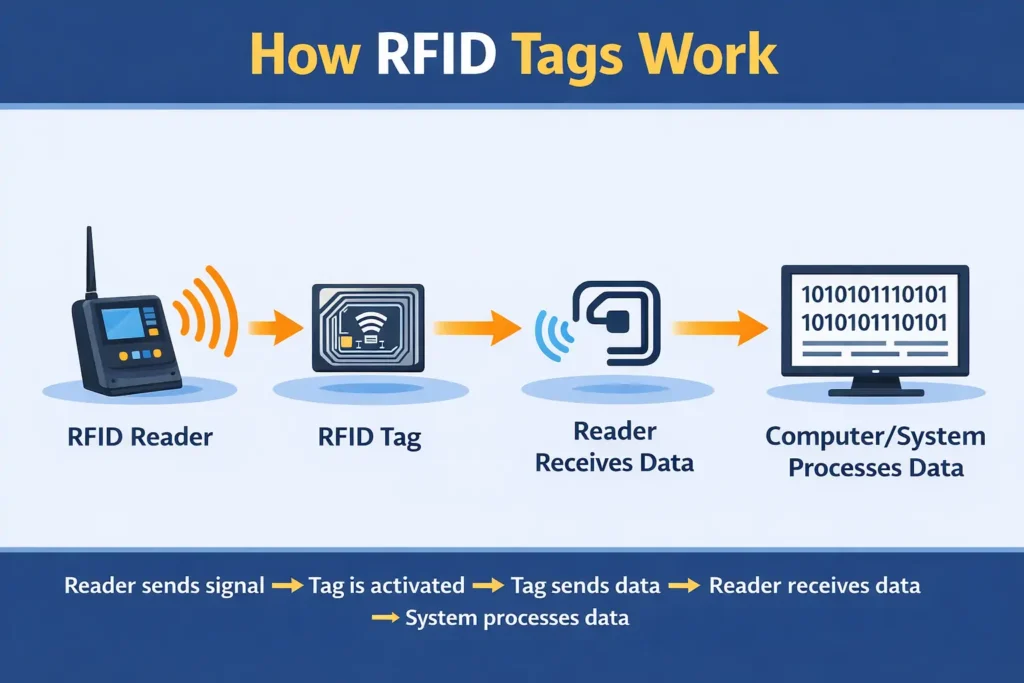
In an RFID asset tracking system, an RFID tag is attached to an asset. The tag contains a small chip and an antenna. The chip stores data, usually a unique ID. The antenna allows the tag to communicate with an RFID reader.
Passive RFID tags do not have their own battery. They stay inactive until they enter the reader’s radio field. When the reader sends out a signal, the tag uses energy from that signal to respond with the data stored in its chip.
For asset tracking, the tag usually does not hold the full asset record. It may store an EPC, serial number, or another asset ID. The full record stays in the software system, including the asset name, category, owner, status, location, and movement history.
Passive UHF RFID is widely used in asset tracking because it can support longer read distances than HF/NFC systems and can read many tags quickly. This makes it useful for inventory counts, tool rooms, warehouse assets, returnable containers, equipment tracking, and other workflows where assets need to be identified in groups or at known scan points.
RFID asset tracking is mainly about identification. It tells the system which tagged asset was read, when it was read, and where the read happened.
How RFID Asset Tracking Works
An RFID asset tracking system starts by assigning a unique ID to each asset. That ID is written to the RFID tag and linked to the asset record in the database.
When the asset enters a read zone, the RFID reader sends a radio signal through its antenna. A passive tag receives energy from that signal, activates for a short moment, and sends back its stored data. In passive UHF RFID systems, this response is commonly based on backscatter communication, where the tag changes how it reflects the reader’s signal.
The reader captures the tag ID and sends it to the tracking software. The software then matches the ID to the asset record. A single scan event may include the tag ID, read time, reader location, antenna position, and the action connected to that read, such as inventory check, check-out, return, or gate pass.
In real systems, the software may also filter repeated reads. A fixed reader may detect the same tag many times in a few seconds, so the system needs rules to decide which reads matter.
This is why passive RFID is best understood as scan-based asset tracking. It does not continuously report location by itself. It updates the asset record when the tag is read by a handheld reader, fixed reader, portal, smart shelf, cabinet, or another RFID read point.
What Is BLE Asset Tracking?
BLE stands for Bluetooth Low Energy. It is a low-power Bluetooth technology designed for devices that send small amounts of data while using less energy than Classic Bluetooth.
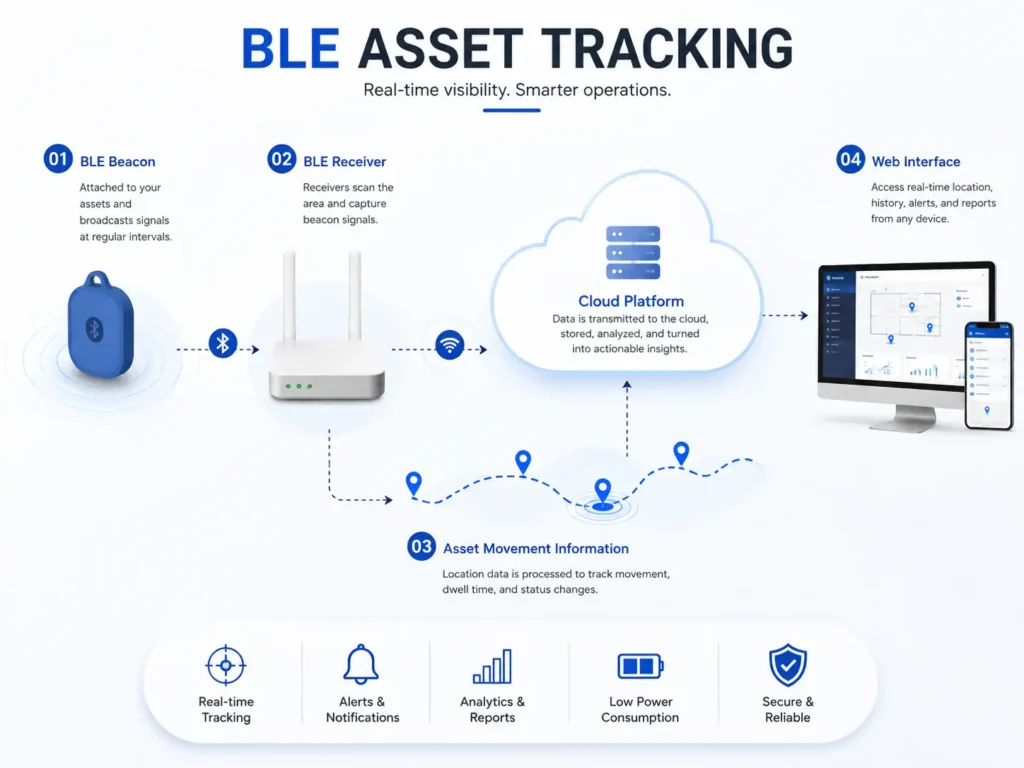
In BLE asset tracking, a battery-powered tracker is attached to an asset. This tracker is often called a BLE tag, BLE beacon, Bluetooth tag, or Bluetooth asset tracker. The wording may change, but the basic idea is the same: the device sends Bluetooth Low Energy signals that nearby receivers can detect.
BLE is different from passive RFID because the tracker has its own power source. It does not need a reader to energize it. Instead, it broadcasts signals at set intervals. These signals can be picked up by phones, gateways, anchors, or other Bluetooth receivers.
A BLE tracker usually broadcasts an identifier rather than a full asset record. The tracking platform links that identifier to the asset record in software. The system can then show whether the asset is nearby, which area it is in, or whether it has moved away from a defined zone.
BLE asset tracking is mainly about presence and visibility. It is useful when assets move freely and the system needs updates without someone scanning each item by hand.
How BLE Asset Tracking Works
A BLE asset tracker sends small advertising packets at regular intervals. These packets usually contain an identifier and basic signal information. The interval can be short or long, depending on how often the system needs updates and how much battery life the tracker must preserve.
Nearby receivers listen for these broadcasts. A receiver may be a fixed gateway on a wall or ceiling, a mobile phone, or a positioning anchor. When it detects the tracker, it records data such as the tracker ID, signal strength, detection time, and receiver location.
The tracking platform uses this data to decide what the asset status should be. In a simple setup, the system may only show that the asset is nearby. In a more developed setup, it may estimate which room, zone, or area the asset is in. Some systems use multiple receivers to compare signals and improve location estimates.
Signal strength is often part of BLE location logic, but it is not a perfect distance measurement. Walls, people, shelves, metal objects, receiver placement, and other 2.4 GHz wireless signals can affect the result. This is why BLE tracking performance depends heavily on gateway layout, tracker settings, and the physical environment.
Battery life is another key part of BLE tracking. A tracker that broadcasts more often can give fresher updates, but it uses more power. A tracker that broadcasts less often can last longer, but the system may update more slowly.
BLE asset tracking turns repeated wireless detections into asset presence, area location, movement history, or alerts. It is not just about reading an ID once. It is about receiving signals often enough to keep the asset visible in the system.
RFID vs BLE: Main Differences
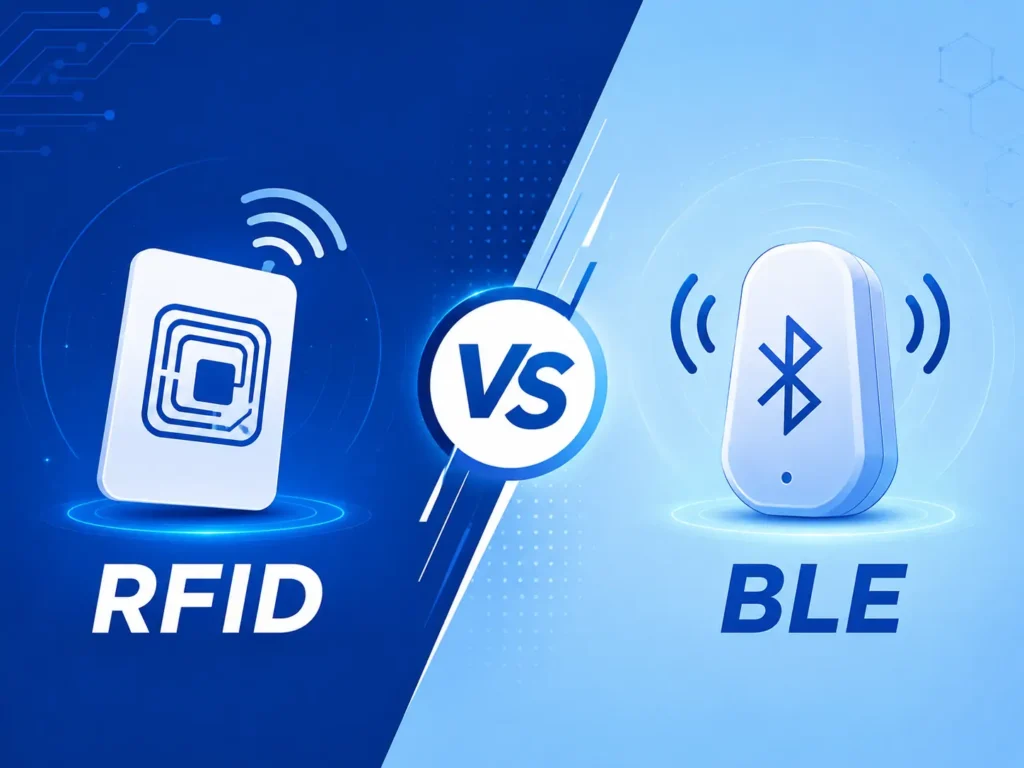
RFID and BLE are often compared because both can identify tagged assets. The deeper difference is how each system collects tracking data.
RFID depends on a reader. The asset is recorded when the tag enters a read zone and responds to the reader’s signal.
BLE depends on the tracker. The asset carries a powered device that broadcasts signals on its own, and nearby receivers listen for those signals.
| Factor | RFID Asset Tracking | BLE Asset Tracking |
| Tag power | Passive RFID tags usually do not need batteries | BLE trackers need batteries |
| Data collection | Reader scans the tag | Tracker broadcasts signals |
| Tracking style | Scan-based identification | Signal-based visibility |
| Update timing | Updates when the tag is read | Updates based on broadcast interval and receiver detection |
| Coverage model | Controlled read zones | Receiver or gateway coverage areas |
| Asset data | Usually reads a tag ID linked to software | Usually detects a tracker ID linked to software |
| Maintenance | Tag mounting and reader setup matter most | Battery life and tracker replacement matter most |
| Cost pattern | Lower tag cost, more reader and antenna planning | Higher device cost, plus battery and platform planning |
| Best fit | Large-scale asset identification and inventory events | Large-scale asset identification and inventory events |
Tracking Method
RFID asset tracking is reader-led. The reader creates the read zone, and the tag responds only when it is close enough to be powered and read. The system records the asset because the reader detected the tag at that point.
This works well when the business process already has clear scan moments. A worker scans a storage room. A portal reads assets moving through a doorway. A cabinet records which tagged tools are inside. The tracking record is tied to the read event.
BLE asset tracking is tracker-led. The BLE tracker sends signals at set intervals, even when no one is actively scanning it. Phones, gateways, or anchors nearby receive those signals and pass the data to the software.
This works better when assets move freely and the system needs to keep listening. The tracker is not waiting for a handheld scan. It keeps announcing itself, and the system uses those repeated detections to judge presence, movement, or location.
Real-Time Visibility
Passive RFID is not naturally continuous tracking. It can update asset status very quickly when a tag is read, but it only creates data at read points.
A fixed RFID portal can show that an asset passed through a doorway. A smart cabinet can show that a tagged item was removed or returned. A handheld reader can confirm which assets are in a room during a scan. In each case, the record depends on a read event.
BLE can provide more continuous visibility because the tracker broadcasts again and again. The system may receive updates every few seconds, every minute, or at another interval set by the tracker configuration.
Battery and Maintenance
Passive RFID tags do not need battery replacement. Once the tag is attached and encoded, it can work for a long time as long as the tag is not damaged, removed, or placed in a way that blocks reliable reading.
RFID maintenance usually focuses on the system around the tag. Reader placement, antenna direction, read zone tuning, tag position, and software filtering all affect performance.
BLE trackers need battery planning from the start. A tracker with frequent broadcasts gives fresher location updates, but it uses more power. A tracker with slower broadcasts can last longer, but the system receives less frequent updates.
For BLE projects, maintenance is not only about the tag staying attached. It also includes battery status, replacement schedules, offline trackers, and the labor needed to keep powered devices working across many assets.
Read Range and Coverage
RFID coverage is built around read zones. A handheld reader covers the area where the worker points it. A fixed reader and antenna cover a doorway, shelf, cabinet, dock door, or work area. The goal is to make the read zone controlled enough that the system knows what the read means.
This is useful when the process has clear physical points. If a tagged asset passes through a gate, the system can treat that read as a movement event. If a tag is read inside a cabinet, the system can treat it as present in that cabinet.
BLE coverage is built around receiver placement. A BLE tracker can only be detected where there are phones, gateways, anchors, or other receivers listening for its signal. To cover a large site, the system needs enough receivers in the right locations.
Accuracy and Environment
RFID accuracy is usually about read confidence and read zone control. The system needs to read the right tags and avoid unwanted reads from nearby areas.
In a well-designed RFID setup, a read can give strong proof that a tag was detected at a specific reader, shelf, cabinet, or doorway. But RFID does not automatically give a live map position. It tells the system where the tag was read.
BLE accuracy is usually about location estimation. A simple BLE setup may only show that an asset is nearby. A stronger setup may estimate a room, zone, or area by using receiver location, signal strength, and repeated detections.
BLE signals can change as the environment changes. Walls, people, shelving, metal objects, floor layout, and other 2.4 GHz devices can affect signal strength. RFID also has environmental limits, especially around metal, liquid, dense stacking, and poor tag orientation.
Cost and Scalability
RFID is often more scalable when many assets need basic identification. Passive RFID labels and hard tags are usually lower-cost than powered BLE trackers, so RFID can be practical for large asset counts.
The main RFID cost often sits in readers, antennas, installation, encoding, and software setup. Once the system is in place, adding more passive tags can be relatively affordable.
BLE has a different cost structure. Each tracker includes electronics and a battery, so the cost per asset is higher. The system may also need gateways, cloud software, battery replacement, and more ongoing device management.
BLE can still be worth the cost when the asset value is high or the labor cost of searching is high. It is less about tagging everything cheaply and more about keeping important mobile assets visible.
Tag Size and Asset Fit
RFID tags can be made in many small and thin formats. A passive RFID label can be used on boxes, files, containers, tools, uniforms, and equipment. Hard RFID tags are available for tougher surfaces, outdoor use, and on-metal assets.
BLE trackers are usually larger because they need a battery, circuit board, and housing. They must also be attached in a way that protects the device and keeps the signal usable.
This affects which assets are practical to tag. RFID is easier to apply to small, low-cost, or high-volume items. BLE is better reserved for assets where the tracker size, battery, and cost make sense.
RFID vs BLE: How To Choose the Right Technology
Choose RFID when the main goal is to identify assets at specific moments. Common RFID use cases include:
- Fast asset identification
- Large inventory counts
- Low-cost tags across many assets
- Check-in and check-out records
- Fixed scan points
- Handheld or batch reading
- Asset records based on scan events
Good examples include warehouse assets, returnable containers, tools, IT assets, files, uniforms, medical supplies, and equipment that moves through known checkpoints.
Choose BLE when the main goal is to keep assets visible over time. The common use cases include:
- Ongoing asset visibility
- Proximity alerts
- Area or room-level location
- Movement history
- Search-and-find functions
- Tracking without manual scanning
- Updates from the asset itself
Good examples include hospital equipment, mobile tools, carts, high-value devices, rental equipment, and assets that staff need to find quickly.
Can RFID and BLE Be Used Together?
Yes. RFID and BLE can be used in the same asset tracking system, but they should not be used for the exact same job without a clear reason.
The most common approach is to use them for different asset groups. Low-cost or high-volume assets can use RFID tags for identification and inventory. Higher-value mobile assets can use BLE trackers when they need ongoing visibility.
Another approach is to use them at different points in the same workflow. RFID can record fixed events, such as check-in, check-out, storage return, gate reads, or cabinet reads. BLE can then help track the asset after that point, as long as it stays within Bluetooth receiver coverage.
A more advanced setup can bind both IDs to the same asset record. The asset may have an RFID EPC for scan events and a BLE beacon ID for presence or location events. When an RFID reader detects the EPC, the system updates the scan history. When a BLE gateway detects the beacon ID, the system updates the asset’s latest presence or area location.
This type of setup only works well when the software can handle both data sources. The platform must know that the RFID tag and the BLE tracker belong to the same asset. Otherwise, the system may create two separate records for one physical item.
RFID and BLE work best together when each technology has a clear role. RFID handles identification. BLE handles ongoing visibility.
FAQs About RFID vs BLE Asset Tracking
Can BLE replace RFID for inventory counting?
BLE can identify assets, but it is usually not the best replacement for RFID in high-volume inventory counting.
Passive RFID is better when many items need to be counted quickly with handheld readers, portals, cabinets, or fixed read points. RFID tags are usually smaller and lower-cost, and passive tags do not need batteries.
BLE is better when the system needs repeated signals from selected assets. It can help show whether an asset is nearby or in a certain area, but putting BLE trackers on every low-cost item is often too expensive and too hard to maintain.
Can one asset use both an RFID tag and a BLE tracker?
Yes. One asset can use both if the tracking system supports it.
For example, the RFID tag can be used for inventory scans, check-in records, or gate reads. The BLE tracker can be used for area visibility, movement updates, or proximity alerts.
The important part is software mapping. The asset record should store both the RFID tag ID and the BLE tracker ID, so both types of data update the same asset instead of creating duplicate records.
Do RFID and BLE need the same software?
Not always.
Some asset tracking platforms support RFID only. Some support BLE only. Some can collect data from both RFID readers and BLE gateways.
If you plan to use both, check whether the software can connect RFID tag reads, BLE detections, asset records, user actions, and location history in one system. If not, the data may stay separated, and the system will be harder to manage.
Is BLE accurate enough for room-level asset tracking?
BLE can support room-level tracking, but it depends on the system design.
A basic BLE setup may only show that an asset is nearby. Room-level tracking usually needs enough gateways or receivers placed in the right locations. The software also needs rules to judge which room or zone the asset most likely belongs to.
Walls, people, shelves, metal objects, and receiver placement can all affect signal strength. BLE should not be treated as automatically room-accurate without testing the actual site.
Can passive RFID show the last known location of an asset?
Yes, but only based on the last read event.
If an asset was last scanned by a handheld reader in a tool room, the system can show that tool room as the last known location. If it passed through a fixed portal, the system can record that doorway or zone as the last known point.
Passive RFID cannot keep updating the location after the asset leaves the read zone. The last known location is only as fresh as the last successful read.
Which technology is better for small assets?
RFID is usually better for small assets because passive RFID tags can be thin, light, and low-cost.
BLE trackers are larger because they need a battery and housing. They may not fit well on small tools, documents, garments, files, or low-cost items.
BLE makes more sense when the asset is large enough, valuable enough, and mobile enough to justify a powered tracker.
Conclusion
RFID and BLE are both useful for asset tracking, but they are built for different tracking needs.
Use RFID when you need to identify assets during scans, inventory checks, returns, or movement through known read points. It is practical for large asset counts, low-cost tags, and workflows based on scan events.
Use BLE when you need assets to stay visible over time. It is better for mobile assets that need presence updates, area location, proximity alerts, or search-and-find support.
The right choice starts with the tracking question. If you need to know what was scanned, RFID is usually the better fit. If you need to know where an asset is now, BLE is usually the better fit.