Chances are, if you’ve ever tapped an RFID card at an office door, scanned a wristband at an event, used a hotel key card, or tracked a product label in a warehouse, you’ve already used an RFID serial number.
You may not have seen the number printed on the tag.
But when an RFID reader scans the tag, that serial number is often the first piece of information captured and sent to the back-end computer system.
Not quite following me?
Well, an RFID serial number is the digital identity of an RFID tag. It helps a system recognize one tag from another, match the tag to a database record, and decide what should happen next.
What Is an RFID Serial Number?
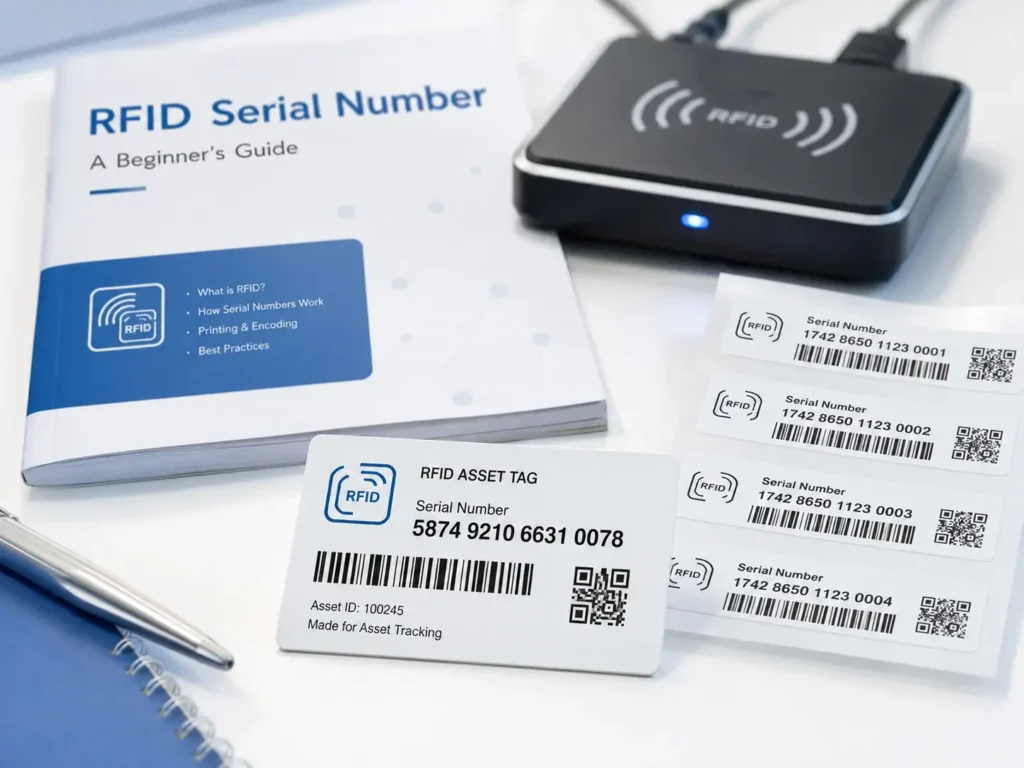
An RFID serial number is a unique identification number connected to an RFID chip, card, wristband, label, key fob, or other RFID-enabled object.
When the tag is read, the reader captures this number and transmits it to software. The software then checks the number against a database. Depending on the application, the system may allow entry, update an inventory record, process a payment, identify an animal, track a garment, or confirm that an asset has been scanned.
The serial number itself does not usually hold all the useful information.
For example, an RFID wristband used at a festival may not store a person’s full name, payment history, and ticket details directly on the band. Instead, the wristband sends a serial number to the system. The system then finds the account or ticket record connected to that number.
The RFID serial number is usually the link between the physical tag and the digital information behind it.
How RFID Serial Numbers Work
An RFID tag contains a small chip and an antenna. The chip holds the tag’s identifying data, while the antenna allows the tag to communicate with a reader through radio frequency signals.
When an RFID reader scans the tag, it sends out a radio signal. A passive RFID tag uses energy from that signal to power the chip for a short moment. Once powered, the chip responds by sending back its stored identification data.
That data may be a factory-set Unique Identifier (UID), a 125kHz card number, an Ultra-High Frequency (UHF) Electronic Product Code (EPC), or another encoded serial number used by the system.
The reader captures the number and passes it to a controller, software platform, or back-end system. From there, the system decides what the scan means. It may show a staff profile, open a door, count a product, confirm a ticket, or record the last known scan point of an item.
The simplest everyday comparison is a barcode.
A barcode also gives a system a number to look up. But RFID does not need direct line of sight, and many RFID tags can be read more quickly than printed barcodes. The reader does not need to “see” the tag in the same way a barcode scanner must see the printed code.
Is an RFID Serial Number the Same as a UID?
Sometimes. But not always.
This is where RFID terminology can get confusing. People often use “RFID serial number,” “UID,” “tag ID,” “chip number,” “card number,” and “EPC” as if they all mean the same thing.
In some systems, they do.
In others, they are different numbers stored in different memory areas of the chip.
A UID usually refers to a factory-set unique identifier. It is built into many RFID chips during manufacturing and is normally read-only. A serial number is a broader term. It may refer to the UID, an EPC number, a printed number, or a custom number encoded by the supplier.
So if someone asks for the RFID serial number, the better question is: which number does your system actually read?
RFID Serial Number vs UID vs EPC vs TID
Before replacing old tags or ordering pre-encoded RFID tags, it is important to know which identification field your system reads. Otherwise, the new tags may scan correctly but fail to match the existing software.
| Term | What It Usually Means | Common Use |
| RFID Serial Number | A general name for the number used to identify an RFID tag | Access cards, wristbands, labels, asset tags |
| UID | A factory-set unique identifier in many RFID chips | High-Frequency cards, Near Field Communication tags, some Low-Frequency systems |
| EPC | Electronic Product Code, the main identity code used in many UHF RFID systems | Inventory, logistics, apparel, warehouse tracking |
| TID | Tag Identification memory, a chip identification area in UHF RFID tags | Chip verification and anti-counterfeit checks |
| Printed Number | A visible number printed on the tag surface | Human checking, manual entry, tag management |
The EPC is usually the number used in UHF inventory projects. The UID is often the number used in Near Field Communication (NFC), High-Frequency (HF), and many access control projects. The Tag Identification (TID) memory area is more often used when the system needs to verify the chip itself, not just the product code written into the tag.
They all identify something.
But they do not always identify the same thing.
Where Is the RFID Serial Number Stored?
The serial number is stored inside the RFID chip, but the exact memory area depends on the chip type and frequency.
In many 125kHz Low-Frequency (LF) RFID cards and key fobs, the tag carries a fixed ID. These are commonly used for simple access control, time attendance, parking systems, and membership identification. The reader captures the card number and sends it to the access control system.
In 13.56MHz HF RFID and NFC tags, the chip usually has a UID. Some chips also have writable memory, which can hold URLs, text, user data, or application-specific records. For example, an NFC wristband may have a UID for identification and NFC Data Exchange Format (NDEF) data for opening a webpage on a phone.
In UHF RFID tags, the EPC memory is usually the main identity field. It is commonly encoded with a product, asset, carton, or item number. The TID memory identifies the chip and is normally set by the chip manufacturer.
Can an RFID Serial Number Be Changed?
Some RFID serial numbers can be changed, and some cannot.
A factory UID is normally locked by the chip manufacturer. It is designed to remain the same throughout the life of the tag to guarantee a stable chip identity.
A UHF EPC number is often writable, which means a manufacturer, warehouse, or RFID supplier is allowed to encode each tag with a product code, asset number, carton number, or other custom value before use. Once encoded, the EPC memory can also be locked if the application requires it.
There are also RFID chips with user memory. This area may be used to store extra information, depending on the system. It is not always needed, but it can be useful for special applications where more than a simple ID is required.
Why the Same RFID Tag Number May Look Different
An RFID reader usually captures raw chip data first. After that, the reader, controller, or software converts that data into a readable number based on its own rules. Different systems may use different conversion rules, so the same RFID tag can appear as different numbers on different readers.
The same RFID chip may be shown as decimal, hexadecimal, reversed byte order, Wiegand format, facility code plus card number, or a long EPC string.
Common RFID Serial Number Formats
There is no single RFID serial number format used by every reader and every system.
Some systems want a decimal card number. Some want hexadecimal data. Some access control systems use Wiegand output. UHF systems often use EPC codes. NFC tools may show the chip UID in hex.
| Format | Where You May See It | What It Means |
| Decimal | Access systems, printed cards, membership tags | A normal number format using 0–9 |
| Hexadecimal | RFID tools, NFC apps, reader software | A data format using 0–9 and A–F |
| Wiegand | Door access systems | A format that often includes facility code and card number |
| EPC | UHF RFID readers and inventory systems | A structured code used to identify items |
| UID | HF, NFC, and some LF RFID chips | The chip’s built-in identifier |
For small projects, this may not cause any issue. For system replacement, bulk ordering, or custom encoding, it is critical.
Before production, test a sample tag with the actual reader and software. Do not only check whether the tag can be read. Check whether the number appears in the correct format.
Printed Number vs Chip Number
The number printed on an RFID card, wristband, or label is not always the same as the number stored inside the chip.
A printed number is for people to read.
A chip number is for RFID readers to read.
Sometimes they match. Sometimes the printed number is a shortened version of the chip number. Sometimes it is a customer’s own ID number, asset number, employee number, or ticket number. In some projects, the printed number has no direct relationship with the chip UID at all.
This is not a problem if the system is planned correctly.
But it can become a problem when a buyer assumes the printed number and chip number are automatically the same.
If you need the surface number to match the encoded RFID number, tell the supplier before production.
How Much Data Does an RFID Serial Number Hold?
Most RFID serial numbers are small.
They are designed to identify a tag, not to store a full customer record, medical file, product history, or payment account directly on the chip.
A 125kHz tag may carry a short fixed ID. An HF or NFC chip may have a UID and additional memory, depending on the chip model. A UHF RFID tag often uses an EPC code, such as a 96-bit EPC, to identify an item in a supply chain or inventory system.
For many projects, this is enough.
The useful data is usually kept in the back-end database. The RFID serial number simply tells the system which record to open.
Can RFID Serial Numbers Be Duplicated?
They can be, depending on the chip and system.
Many RFID chips have factory-set identifiers that are designed to be unique. However, some low-cost RFID cards and fobs can be copied, especially when the system only checks a simple ID number and does not use stronger authentication..
For simple attendance, basic membership, or low-risk asset tracking, a standard ID may be enough. For payment, secure access, ticketing, anti-counterfeit, or restricted areas, the system may need encrypted chips, password protection, access keys, locked memory, or database-level duplicate checks.
Can RFID Serial Numbers Be Used for Tracking?
Yes, but with limits.
An RFID serial number can help a system record where and when a tag was scanned. For example, a warehouse system may record that an asset was read at a gate. An event system may record that a wristband entered a VIP area. A laundry system may record that a linen tag passed through a washing station.
However, most passive RFID tags do not broadcast their location all the time. They only respond when they are within the reading range of a compatible RFID reader.
So an RFID serial number does not work like GPS.
It can show the last known scan point. It can support movement history, check-in records, and process tracking. But it cannot continuously track a person or item without readers installed at the right points.
RFID Serial Number Jargon Buster
Tag / Chip: The small RFID component inside a card, wristband, label, fob, or other RFID product. It stores the identifying data and communicates with the reader through radio frequency signals.
Reader / Scanner: The device that sends a signal to the RFID tag, captures the tag number, and transmits the data to a controller or back-end system.
UID: Unique Identifier. A chip identifier built into many RFID chips. It is usually set by the chip manufacturer and cannot normally be changed.
EPC: Electronic Product Code. A common identity code used in many UHF RFID systems to identify products, cartons, assets, and inventory items.
TID: Tag Identification. A UHF RFID memory area that helps identify the chip itself and is often used for verification.
NDEF: NFC Data Exchange Format. A standard data format used by NFC tags and NFC-enabled devices for records such as URLs, text, and application data.
Encoding: The process of writing data into an RFID tag, such as an EPC number, custom serial number, or user memory value.
Read-Only: A memory area that cannot normally be changed after manufacturing or locking.
Read/Write: A memory area that can be written, updated, or locked, depending on the chip and system settings.
Wiegand: A common access control output format used by many card readers and door controllers.
Final Thoughts
An RFID serial number sounds simple at first. It is the number a reader captures when a tag is scanned.
But in actual RFID projects, the number may be a UID, EPC, TID, card number, printed number, or custom encoded value. It may be fixed at the factory, written before delivery, shown in decimal, displayed in hex, or converted by the reader into another format.
The safest approach is to start with the reader and software, then choose the right RFID chip, serial number format, encoding method, and printed number plan from there.