
NFC payment allows you to pay by holding a contactless bank card, phone, or smartwatch close to a compatible payment terminal. NFC handles the short-range wireless connection, while the card chip, terminal, payment network, and bank handle the actual transaction.
A tap may take only a second, but several steps happen during that time. The payment device communicates with the terminal, creates security data for the transaction, and sends the payment through the banking network for approval.
What Is NFC Payment?
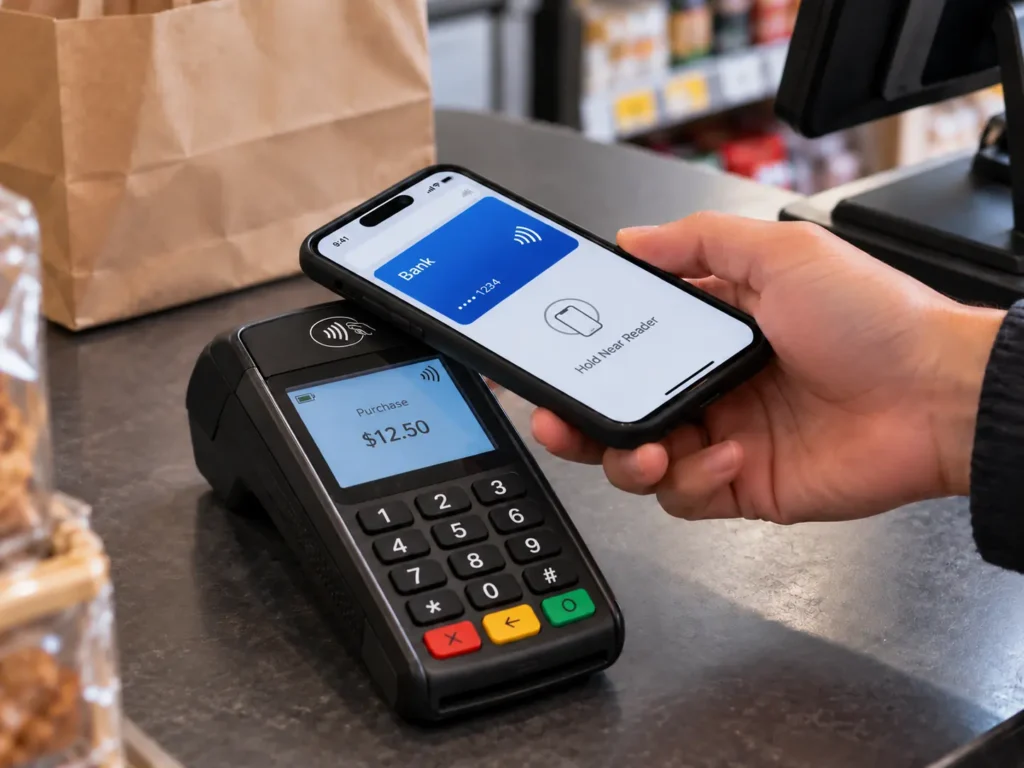
NFC, or Near Field Communication, is a short-range wireless technology that operates at 13.56 MHz. In payments, it allows a payment card or mobile device to communicate with a point-of-sale terminal without being inserted into the reader.
EMV Contactless supports payments from both contactless chip cards and NFC-enabled mobile devices. The card or device only needs to be held very close to the terminal.
Common NFC payment methods include contactless debit and credit cards, Apple Pay, Google Pay, and payment-enabled smartwatches.
The NFC connection itself does not move money between accounts. It provides the local communication link between the payment device and the terminal. The rest of the transaction passes through the normal payment infrastructure.
How Does NFC Payment Work?
A typical contactless card transaction can be divided into five stages.
1. The Terminal Activates the Card
The merchant first enters or confirms the purchase amount. The payment terminal then creates a radio-frequency field around its contactless reader.
A physical contactless bank card does not need its own battery. Its internal antenna picks up energy from the terminal’s field and supplies enough power for the chip to operate.
Therefore, a contactless card sometimes can sit unused in a wallet for years and still communicate with a terminal when you tap it.
Phones and smartwatches are different because they have their own power source, although they still use the same short-range contactless interface when communicating with the payment terminal.
2. The Card and Terminal Establish Communication
Once the card enters the terminal’s field, the terminal and card begin communicating.
Contactless payment cards commonly use technology based on ISO/IEC 14443. EMV specifications then define how the payment application and terminal exchange the information required to process the transaction.
The terminal identifies an available payment application and begins the EMV transaction. At this point, the card is doing more than simply sending a stored card number.
3. The Card Generates Transaction Data
The payment chip holds credentials and cryptographic information issued as part of the payment card system.
During a transaction, it uses these credentials to generate security data specific to that payment. EMV describes this as a one-time security code or cryptogram. A new value is generated for another transaction rather than using the same fixed security code each time.
The transaction can also include information supplied by the terminal, such as the purchase amount and other transaction parameters.
4. The Transaction Is Sent for Authorization
After communicating with the card, the terminal sends the payment into the financial network.
A simplified route looks like this:
Card or phone → POS terminal → merchant’s acquirer/payment processor → card network → issuing bank
The issuing bank is the bank or financial institution responsible for the customer’s card.
It receives the transaction information and performs the checks required to decide whether the payment should be accepted. These can include validating the payment credentials and cryptographic data and checking the account and transaction status.
5. The Approval or Decline Returns to the Terminal
The issuer returns its decision through the payment network.
If approved, the POS terminal confirms the payment. If declined, the terminal receives the corresponding response instead.
The entire exchange often finishes within a few seconds.
Settlement of the money between the financial institutions happens separately. The tap at the terminal mainly handles transaction authentication and authorization rather than instantly transferring money from one bank account directly into the merchant’s account.
Does NFC Payment Require an Internet Connection?
The short-range NFC exchange itself does not require a cellular or Wi-Fi connection on the customer’s phone. However, a typical merchant payment terminal needs access to the acquirer or payment processor to request online authorization. Some payment environments may support limited offline, deferred, or store-and-forward processing under specific rules.
What Is Inside a Contactless Bank Card?
A contactless debit or credit card is a specialized contactless smart card.
Inside the plastic card are two important components: a secure chip and an antenna. The antenna normally runs around a large part of the card so it can couple with the electromagnetic field produced by the terminal.
The chip contains the payment application and protected information required for payment transactions. It can perform cryptographic operations instead of behaving like simple readable memory.
This also explains why damaging the antenna can stop contactless payment even when the visible chip contacts on the front of the card still work. Contact payment through the metal contacts and contactless payment use different physical interfaces to communicate with the chip.
So is a contactless bank card an NFC card?
For normal usage, yes: it is a card that participates in NFC/contactless communication at 13.56 MHz. More precisely, it is a secure payment smart card built for EMV contactless transactions rather than a general-purpose NFC tag.
What Information Is Exchanged During an NFC Payment?
It is sometimes said that contactless cards simply “send your card details.” That description leaves out the most important part of the process.
Some payment information can be transmitted during the transaction. Visa, for example, states that its contactless cards can transmit the account number, expiration date, and a one-time code that changes for each in-person transaction.
The important distinction is between relatively static account information and dynamic transaction security data.
The account information identifies the payment account. The dynamically generated cryptographic value helps the issuer determine whether the transaction came from a valid payment credential and whether the transaction data is valid.
A captured contactless exchange therefore does not provide another device with a reusable cryptogram that can simply be presented again for a new EMV contactless transaction. The security value is tied to the individual transaction.
That does not mean payment information should be treated as non-sensitive. It means EMV contactless security does not rely only on keeping a card number secret.
How NFC Payments Work on Phones and Smartwatches
A phone can communicate with the same type of contactless payment terminal, but it does not necessarily present the same payment credential as the physical card stored in your wallet.
Mobile wallets commonly use payment tokenization.
When a compatible card is added to Google Pay, for example, a device token, also called a DPAN or virtual account number, can be provisioned to the device. Google states that this device token is sent to the terminal instead of the card’s actual primary account number during an NFC payment.
Apple Pay uses a similar device-specific approach. Apple states that a Device Account Number is stored in the device’s Secure Element and is used together with transaction-specific dynamic security data. The actual payment card number is not sent by the device during an Apple Pay transaction.
The general payment route is still familiar:
Phone → NFC payment terminal → payment network → issuer
What changes is the credential presented by the device.
Phones and watches can also add device-level cardholder verification. Depending on the device and wallet, the user may authenticate with Face ID, a fingerprint, a passcode, or another approved method before the payment credential is used.
The NFC interface therefore remains only one part of mobile payment. Secure hardware, token provisioning, user authentication, and payment-network processing work behind it.
Does Contactless Payment Always Require a PIN?
No. Whether a PIN or another cardholder verification method is required depends on factors such as the transaction amount, issuer rules, terminal configuration, payment network rules, and local regulations. A contactless card transaction may sometimes require the customer to enter a PIN. On a phone or smartwatch, successful biometric or passcode verification may serve as a Consumer Device Cardholder Verification Method, commonly called CDCVM.
NFC Payment Cards vs Standard NFC Tags
A contactless bank card and a standard NFC tag may both communicate at 13.56 MHz, but their capabilities are very different.
| Feature | Contactless Payment Card | Standard NFC Tag |
| Main purpose | Financial transactions | Store or provide NFC data |
| Typical communication | Contactless/NFC-compatible | NFC |
| Common data | Payment credentials and transaction data | URLs, text, IDs, app data |
| Payment cryptography | EMV payment cryptography | Not normally supported |
| Payment credentials | Issued through payment infrastructure | Not present on normal tags |
| Typical examples | Debit and credit cards | NTAG213, NTAG215, NTAG216 |
Standard NFC chips such as NTAG213, NTAG215, and NTAG216 are NFC Forum Type 2 tags. They provide user memory for applications such as smart advertising, product interaction, authentication, and other NFC experiences. They support NDEF data structures that compatible phones can read.
For example, an NTAG213 could contain a URL such as:
https://example.com/pay/order123
When a customer taps the tag, the phone opens that page and the customer can continue to an online checkout.
The NFC tag has helped start the payment experience, but the tag itself has not performed an EMV bank-card transaction. It simply supplied the data that directed the phone to the payment service.
The same idea can be used in restaurants, unattended kiosks, product packaging, event systems, or other applications where a tap needs to connect a physical object with an online payment page.
Some organizations also use contactless cards or devices in closed-loop systems, where the credential identifies an account within that organization’s own platform. Transit cards, campus systems, stored-value systems, and similar applications may use more capable secure contactless chips. These systems still should not be confused with issuing a normal bank card that works across Visa, Mastercard, or another open payment network.
How Are NFC Payments Secured?
Contactless payment security is built around the payment credential and the cryptographic exchange, not simply around the short reading distance of NFC.
Transaction-Specific Cryptograms
EMV chip transactions generate security data for individual transactions. EMVCo describes the cryptogram as a one-time value that helps the issuer and terminal authenticate the transaction.
If someone records one valid transaction, that cryptographic value cannot simply be reused as the valid cryptogram for another transaction.
Protected Cryptographic Keys
The keys used to generate valid payment cryptograms are protected within the payment credential rather than being transmitted openly whenever the card is read.
The issuer or payment network can use corresponding information to verify the cryptogram during transaction processing.
Tokenization on Mobile Devices
Mobile wallets add another layer by replacing the physical card’s primary account number with a device-specific payment token.
Apple Pay and Google Pay both use device-specific payment credentials for supported contactless payments. Losing the device credential therefore does not require exposing the original card number used to fund it.
This combination of secure credentials, dynamic transaction data, and issuer verification is why NFC payment should not be understood as a reader simply scanning a bank card and trusting whatever number it receives.
Where Is NFC Payment Used?
The same basic contactless payment process can be used anywhere a compatible payment terminal and payment infrastructure are available.
Retail stores and restaurants are the most familiar examples. Contactless terminals are also common in vending machines, parking systems, self-service kiosks, and other unattended payment points.
Public transportation is another major use. Some systems accept ordinary contactless bank cards or mobile wallets directly at the gate. These are often called open-loop systems because existing bank-issued payment credentials are used.
Other transportation, campus, hospitality, and venue systems issue their own cards or credentials. These are closed-loop systems, where the operator controls the credential and the account behind it.
Both may use contactless technology, but the financial system behind the tap determines what the card or device can actually do.
Conclusion
NFC provides the wireless connection that allows a card, phone, or smartwatch to communicate with a payment terminal. The payment chip or mobile wallet supplies the secure credential, the terminal passes the transaction into the financial network, and the issuer decides whether to authorize it.
That division of roles is also important when choosing NFC technology for a project. A programmable NFC tag can connect a customer to a payment page or other digital service, while direct bank-card payment requires the secure credentials and infrastructure of a dedicated payment system.