EAS and RFID are both used to protect or identify tagged items, but they do not solve the same problem. EAS, or Electronic Article Surveillance, is mainly used to detect unpaid items at store exits. RFID, or Radio Frequency Identification, can identify individual tagged items and connect them with data in an inventory, asset, or security system.
This article compares EAS and RFID in plain terms. It explains how each system works, where they are commonly used, and which option makes more sense when you need theft prevention, item tracking, inventory visibility, or custom tag data.
The main difference is simple: EAS tells you that a protected item is passing through a gate. RFID can tell you which item it is.
What Is EAS?
EAS stands for Electronic Article Surveillance. The technology dates back to the mid-1960s. Arthur J. Minasy filed an early patent for an article theft detection system in 1966, and the patent was published in 1970.Since then, EAS has been used in retail for decades as stores moved toward open shelves and self-service shopping. Instead of keeping every product behind a counter, retailers could attach a small tag or label to the item and use detection gates near the exit.
An EAS system usually includes three parts: a tag or label attached to the item, detection gates near the exit, and a checkout process that removes or deactivates the tag. If the tag is still active when the item passes between the gates, the system triggers an alarm.
EAS tags do not usually identify the exact product. They mainly tell the system that an active security tag is present. For example, the alarm may show that a protected item is leaving the store, but it will not usually tell staff the product name, SKU, size, color, or item history.
EAS is mainly used for retail theft prevention. It is common in stores that need a simple way to protect products at the exit without tracking each item individually.
What Is RFID?
RFID stands for Radio Frequency Identification. It uses radio waves to identify a tagged item without direct contact or line-of-sight scanning.
An RFID system usually includes a tag, a reader, an antenna, and software. The RFID tag contains a small chip and antenna. When the tag enters the reader’s signal range, it sends back data from the chip. That data may be a simple unique ID or a code linked to product, asset, or inventory records in a database.
RFID tags can identify individual items. For example, an RFID reader can detect a specific tagged product, not just the presence of a security tag. This allows the system to know which item was scanned, where it was scanned, and whether that item matches the expected record.
RFID is used for inventory tracking, asset management, access control, logistics, laundry tracking, vehicle identification, and retail item management. In retail, RFID can also support loss prevention, but its main value is item-level visibility.
RFID works best when a business needs more than an alarm. It is useful when items need unique identities, batch scanning, data records, or tracking across different points in a process.
EAS vs RFID: Main Differences
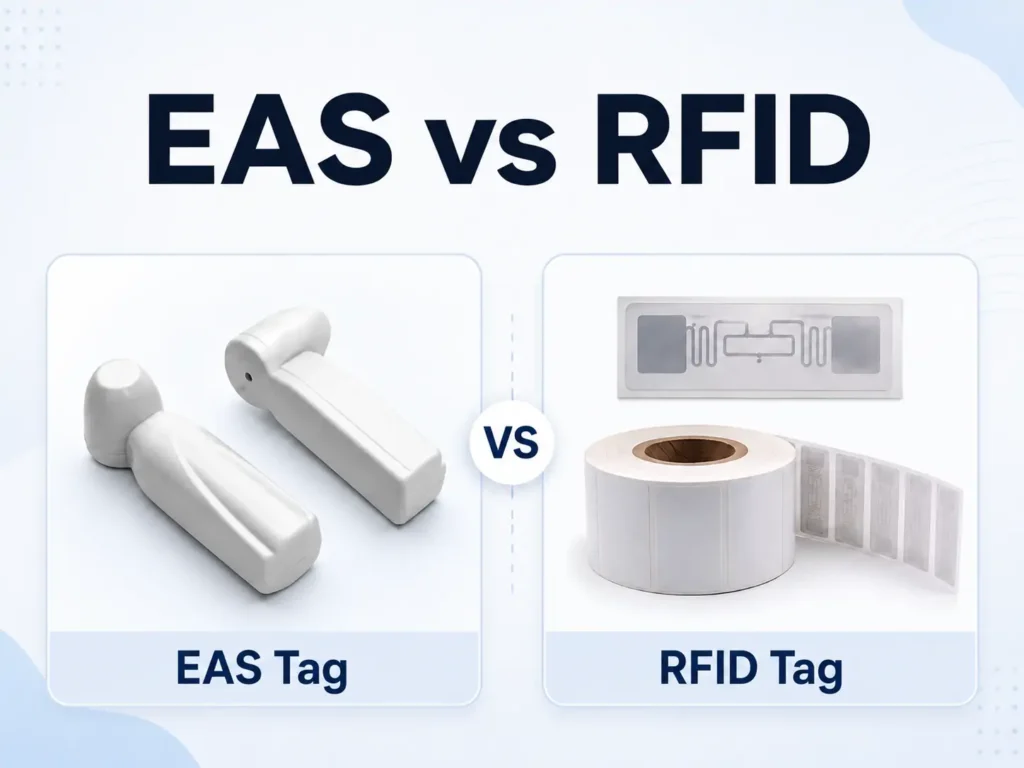
EAS and RFID can both use tags, readers, and detection equipment, but they are built for different levels of control. EAS checks whether a protected tag is present near an exit. RFID reads data from a specific tag and can connect that tag to a product, asset, or record.
| Difference | EAS | RFID |
| Main purpose | Theft detection | Item identification and tracking |
| Data | Usually no item-level data | Can carry or link to unique item data |
| Main hardware | Security tags, labels, and exit gates | RFID tags, readers, antennas, and software |
| Inventory tracking | Limited | Strong |
| Checkout process | Tag is removed or label is deactivated | Tag can remain readable after checkout |
| Best fit | Basic loss prevention | Tracking, inventory, automation, and security |
Purpose
EAS is mainly an alarm system. It detects an active tag when the item passes through a security gate. The system does not need to know the exact item to trigger an alert.
RFID is an identification system. It reads a tag and returns data from that tag. The data can be used for stock counts, item movement, asset records, checkout checks, or security actions.
Data
Most EAS tags only confirm that a tag is active. They do not usually tell the system which product is leaving the store.
RFID tags can carry a unique ID or encoded data. The tag can also link to a database record, such as a SKU, serial number, batch number, or asset record. That item-level data is the main reason RFID can support inventory and tracking tasks that EAS cannot handle.
Hardware
EAS systems usually use security tags or labels with detection gates placed near exits. At checkout, the tag is removed or the label is deactivated.
RFID systems use RFID tags, readers, antennas, and software. The reader sends a radio signal, the tag responds, and the system records the scan. Reader placement, antenna type, tag frequency, and software setup all affect how the system performs.
Inventory Visibility
EAS has limited inventory value because it is built around exit detection. It can help alert staff when an active tag leaves, but it does not normally update stock records or identify each item.
RFID can read many tagged items without scanning each one by hand. A store, warehouse, or asset room can use RFID to count items, find missing stock, check movement, and reduce manual scanning work.
Tag Options
EAS tags are often hard tags, labels, or source-tagged labels used on retail products. The format depends on the product and the checkout process.
RFID tags come in more formats because they are used for different tracking conditions. Common options include RFID labels, hard tags, on-metal tags, laundry tags, seal tags, key fobs, and other custom designs. The tag format should match the item surface, environment, reader system, and data requirement.
Cost And Setup
EAS is usually simpler when the goal is only exit alarm protection. The system needs compatible tags, gates, and checkout deactivation or removal tools.
RFID needs more planning. The tag must match the reader, frequency, surface, and software process. The setup can cost more at the beginning, but it can also support more tasks, such as inventory counts, item tracking, and data records.
EAS vs RFID: Which One Should You Use?
Choose EAS when you only need a simple way to detect unpaid items at the exit. It fits stores that already have a standard checkout process and only need security tags to be removed or deactivated after purchase.
Choose RFID when each item needs a unique identity. RFID is the better fit for inventory counts, stock movement, asset tracking, return checks, and systems that need to know exactly which item was scanned.
For basic retail loss prevention, EAS is often enough. It is simple, familiar, and focused on one task: triggering an alarm when an active tag passes through the detection gate.
For item-level control, RFID gives you more information. An RFID tag can identify the product, connect to a record, and stay useful after checkout or movement. That makes it a stronger option when security is only one part of the process.
RFID can also support anti-theft checks, but it is not a direct plug-in replacement for EAS in every store. The result depends on reader placement, tag type, checkout setup, software rules, and how the item is handled after purchase.
Frequently Asked Questions
Is RFID The Same As EAS
No. EAS and RFID both use tags, but they are not the same technology. EAS is mainly used to detect whether an active security tag passes through a gate. RFID is used to read data from a tag. That data can identify a specific product, asset, container, or item record. The easiest way to compare them is by the result. EAS triggers an alarm. RFID returns item information.
Can RFID Replace EAS
RFID can replace EAS in some systems, but not by simply swapping one tag for another. The store needs the right RFID tags, reader placement, software rules, and checkout process.
RFID can support loss prevention when the system can detect unpaid or unauthorized item movement. It can also give more detail than EAS because the system can identify the exact item being read.
For a store that only needs a basic exit alarm, EAS may still be the simpler option.
Does EAS Track Inventory
EAS does not normally track inventory at the item level. It is built to detect active tags near an exit, not count products or update stock records.
RFID is better suited for inventory tracking because each tag can carry or link to a unique identity. Readers can scan multiple tagged items and send that data to inventory software.
Are RFID Tags More Expensive Than EAS Tags
RFID tags are usually more complex than basic EAS labels because they include a chip and antenna. The final cost depends on the tag type, chip, material, size, printing, encoding, and application.
A simple RFID label is different from an on-metal tag, laundry tag, seal tag, or high-temperature tag. The tag should be selected based on where it will be used and how it needs to be read.
Need Custom RFID Tags?
If RFID is the better fit for your application, the tag format needs to match the item, reader system, and use environment. Different surfaces and working conditions can require different tag materials, chip types, or attachment methods.
Need help choosing custom RFID tags? Send us your tag format, chip requirement, surface material, and application details. We can help check the best option before production.