Waste collection depends on accurate records. Cities, waste companies, and facility managers need to know which bins were collected, when they were collected, where they were collected, and whether any service was missed. Manual checks can be slow and easy to dispute, especially when thousands of bins are handled every day.
RFID waste management gives each bin a unique digital identity. With an RFID tag on the bin and a reader on the truck, the collection process can be recorded automatically. It helps turn normal waste bins, carts, and containers into trackable assets, making waste collection cleaner, faster, and easier to manage.
What Is RFID in Waste Management?
RFID in waste management is the use of RFID tags, readers, antennas, and software to identify and track waste bins, carts, containers, or collection vehicles.
Each RFID tag stores or carries a unique identification number. This tag is attached to a waste bin or built into the bin during production. When the bin is collected, an RFID reader captures the tag data without needing direct line of sight. The system then connects that scan with useful information such as the bin owner, service location, route, truck, collection time, and service status.
In other words, RFID waste management helps answer one key question: what happened to each bin?
It can show whether a bin was collected, missed, moved, replaced, damaged, or assigned to the wrong location. For municipal waste collection, this can reduce disputes and improve service records.
However, RFID does not replace the whole waste management system. It only improves the data behind it.
How RFID Waste Management Works
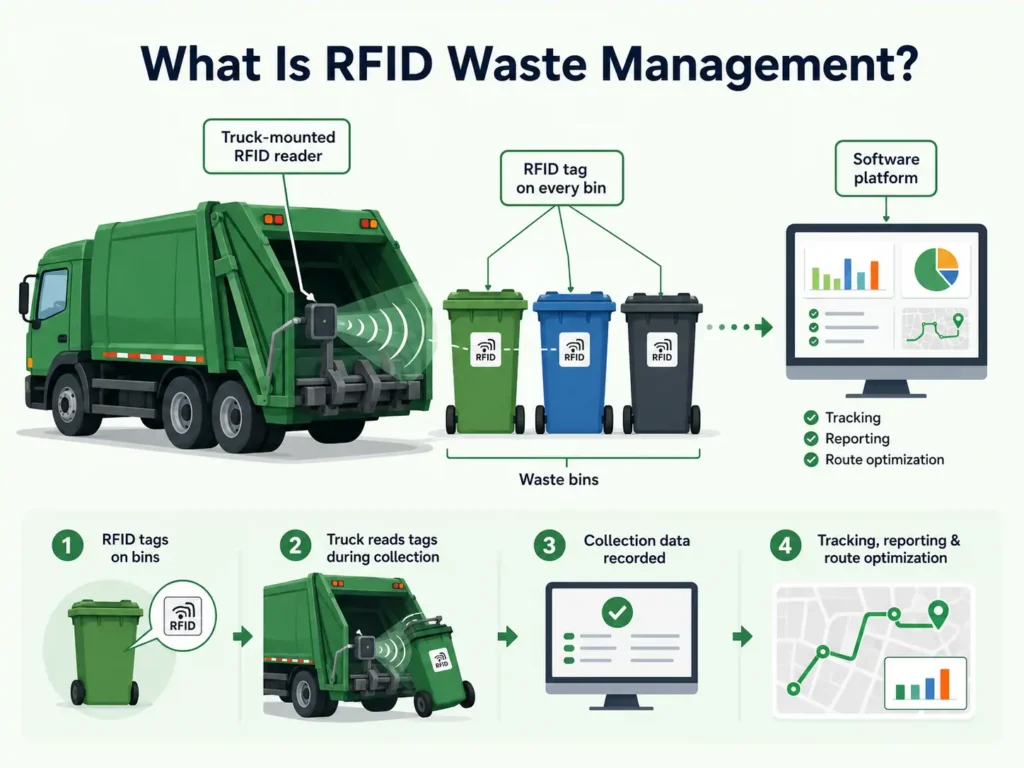
In an RFID waste management system, each bin gets its own RFID identity. Every collection event can be recorded by the system instead of being checked by hand.
The exact setup can vary by project. A city collection program may track household bins. A commercial waste company may track containers at offices, restaurants, or factories. A facility may use RFID to manage internal waste carts. The basic workflow, however, is still the same.
RFID Tags Are Attached To Waste Bins
An RFID tag is fixed to each waste bin, cart, or container. The tag may be attached to the side of the bin, placed under the rim, installed near the handle, or built into a protected area of the container.
The tag gives the bin a unique ID. This becomes the digital identity of that bin inside the waste management system.
For outdoor waste bins, the tag must be strong enough for daily use. It may face rain, sunlight, dirt, washing, vibration, and impact during loading. A normal paper label or basic barcode can wear out quickly in this kind of environment. RFID tags are better suited when the bin needs long-term tracking.
Each Bin Is Linked To A Location Or Account
After the RFID tag is installed, the tag ID is linked to useful records in the software.
For example, the tag for a household bin may be linked to a home address, customer account, waste type, collection route, and service schedule.
Once the bin is registered, the waste company can see where it belongs, who uses it, what service it should receive, and which route it is assigned to.
The Truck Reader Scans The Bin During Collection
When the waste truck reaches the bin, the RFID reader captures the tag data. In many systems, the reader is mounted on the truck near the lifting area. When the bin is lifted or emptied, the reader scans the tag automatically.
The driver does not need to stop and scan a label by hand. The tag can be read as part of the normal collection process.
After the tag is scanned, the software creates a service record for that bin. Depending on the system, the record may include the bin ID, truck ID, route, collection time, location, and service status.
Many waste collection systems also connect RFID data with GPS or fleet tracking. RFID shows which bin was collected, while GPS shows where the truck was and how the route was completed. Together, they give the operator a clearer record of the collection process, including bin service, truck location, route progress, and possible missed stops.
Real Case Studies Of RFID In Waste Management
Real waste collection projects show where RFID adds value beyond simple bin identification. The strongest examples usually connect RFID with route data, customer records, recycling behavior, or billing.
Halden Municipality, Norway
Halden Municipality in southern Norway started its RFID waste collection project from a university student project in 2016. The system later developed into a full hybrid RFID and camera-based solution for local household waste collection. By 2023, all 30,000 waste bins in the city had RFID tags, and each bin ID was linked to a household and GPS location. The tags were placed under the bin lid, and each tag also carried a printed QR code to help connect the bin with the correct household record during setup.
The system helped Halden reduce costs from disputed or inaccurate extra pickup charges. Before the system, the city found gaps between the number of bins billed by the third-party collection company and the number of bins actually emptied. It also reduced repeat pickup claims from residents who said their bins had not been emptied. The recycling data helped the municipality see areas with lower food-waste sorting and target education there. The city reported lower waste collection costs and improved recycling performance after the system was deployed.
Wheaton And Highland Park, Illinois
Lakeshore Recycling Systems used RFID for pay-as-you-throw waste service in Illinois communities including Highland Park and Wheaton. Highland Park had used a volume-based PAYT model since at least 1993. Before RFID, residents had to buy paper stickers from a store, estimate how many they needed, and attach a sticker to the cart each time it was placed out for collection. When the cart was emptied, the waste worker collected the sticker.
With the RFID system, a passive EPC Gen 2 UHF RFID tag was embedded in each trash or recycling cart. The tag ID was linked to the cart size, waste type, and resident billing address in LRS software. An RFID reader was installed on the arm at the front of each garbage truck, where the cart was lifted toward the hopper. When the cart was dumped, the reader captured the tag ID. At the end of the day, the truck returned to the facility and uploaded the tag data by Wi-Fi, updating the billing record for each resident. The reader also stored the time and date of each tag read to confirm when the tip happened.
Wheaton awarded LRS a five-year residential waste and recycling contract effective October 1, 2016. The city had about 14,000 residential households, and the RFID-enabled program linked pickups directly to customer accounts for billing accuracy. A 2021 city memorandum later described the move from a sticker-based PAYT model to an RFID-based PAYT model, with each resident choosing a 35, 65, or 95 gallon cart for garbage and recycling. The same memo said LRS associated each cart with an address for 14,700 residences and that the city manager’s office received only about two to three general complaint calls per month on average after 4.5 years of collection service.
Aspropyrgos, Greece
Aspropyrgos, a fast-growing suburb of Athens, Greece, tested RFID for municipal garbage collection after complaints about missed or infrequent pickups, especially from business owners. The city had grown from an agricultural community of about 2,000 residents in the 1960s to an industrial city of 27,500 people, which put more pressure on public services. The municipality completed a three-month RFID pilot to track garbage collection work in real time.
The pilot was designed and deployed by CAT Hellas. Fifteen of the city’s 2,500 municipal garbage bins were tagged with CAEN RFID A918 tags mounted near the base of the bins. One of the city’s 15 garbage trucks was fitted with a CAEN RFID A949EU reader. The antenna was installed above the rear opening of the truck, where the lifting arms emptied the bins. The tags operated at 867 MHz and followed ISO 18000-6B. Although the reader could read the tags from nearly 5.5 meters, the antenna was tuned down to a range of no more than 1 meter, so it would only read the bin being emptied instead of nearby bins.
The truck system used a metal plate to reduce interference from the truck body. Tag data was sent by Bluetooth to a Qtek S200 PDA mobile phone inside the truck, then uploaded by GPRS to a municipal server with a timestamp. CAT Hellas software matched each tag ID to the database and generated a list of addresses where bins had been emptied and when. The city could use the data to review truck routes, collection times, and collector productivity. After the pilot, the mayor said the information could help improve the city’s garbage collection service overall.
Benefits Of RFID In Waste Management
RFID gives waste operators better field data. Instead of managing collection only through route plans, driver notes, and customer calls, the system can connect each bin with a real collection record.
More Accurate And Efficient Collection
RFID reduces the need for manual checks during waste collection. The driver does not need to write down bin numbers, scan a visible barcode, or confirm each cart by hand.
When the bin is lifted or emptied, the reader can capture the tag automatically. This reduces missed records, wrong bin records, and slow manual steps during busy routes.
For large collection programs, even small errors can become expensive when thousands of bins are handled every day. RFID gives the system a more reliable way to record collection activity at scale.
Verified Service Records
RFID creates a record when a tagged bin is collected. The record may include the bin ID, truck ID, route, collection time, GPS location, and service status.
This gives waste operators a clearer answer when a pickup is questioned. If a customer says a bin was missed, the team can check whether the bin was scanned, when the truck passed the location, and whether the pickup was completed.
It also gives the company a better record for blocked bins, bins not placed out, wrong-route collections, and repeated service issues.
More Accurate Pay-As-You-Throw Billing
RFID is useful for pay-as-you-throw programs because each cart can be linked to a specific household or customer account.
The system can record when a cart is emptied and connect that collection event with the correct account. If the program uses cart size, pickup frequency, or weight data, RFID can support a more accurate billing record.
This can replace paper stickers, manual counting, and driver notes. It also reduces billing problems caused by missing stickers, wrong cart assignments, or unclear pickup records.
Better Bin Asset Management
Waste bins, carts, and containers need to be tracked over their full service life. They are delivered, assigned, moved, repaired, replaced, damaged, and sometimes lost.
RFID gives each bin a permanent identity in the system. Operators can record the bin size, waste stream, assigned address, delivery date, repair history, and replacement status.
For large cart fleets, this makes it easier to find misplaced bins, manage container inventory, and keep records current when residents move or service plans change.
Smarter Route And Fleet Planning
RFID collection data can show how routes perform in the field. Operators can compare planned routes with actual pickup activity, truck movement, and service times.
When RFID is connected with GPS, the route record becomes more detailed. Managers can see pickup patterns by route, truck, service zone, or time of day.
Stronger Recycling And Sustainability Data
RFID can give recycling programs more detailed data than total waste volume alone. A city or waste operator can see which recycling bins are being collected, how often they are used, and where participation is low.
Some systems connect RFID with cameras, weighing equipment, or inspection records. This can show food-waste sorting, recycling participation, contamination problems, or waste reduction progress by household, route, or service area.
RFID is not sustainable by itself. It gives waste teams the data they need to manage recycling programs, reduce unnecessary collection trips, and understand waste behavior more clearly.
RFID Waste Management Vs Barcode Tracking
RFID and barcode tracking can both identify waste bins, carts, and containers. The difference is how the data is captured.
A barcode needs a visible label and a direct scan. RFID uses radio frequency signals, so the tag can be read without a clear line of sight. This difference matters in waste collection because bins are often dirty, wet, scratched, blocked, or moving during pickup.
| Feature | RFID Waste Management | Barcode Tracking |
| Reading Method | Read by radio signal | Read by optical scanner |
| Line Of Sight | Not required | Required |
| Collection Workflow | Can be read during lifting or emptying | Usually needs manual aiming and scanning |
| Outdoor Durability | Tag can be protected inside or on the bin | Printed label can fade, tear, peel, or get dirty |
| Read Speed | Faster for automated collection records | Slower when workers must scan one by one |
| Data Accuracy | Better for high-volume route tracking | Depends more on worker action and label condition |
| Equipment Cost | Higher system cost | Lower starting cost |
| Best Fit | Municipal waste collection, pay-as-you-throw programs, commercial bin tracking, large cart fleets | Small sites, low-cost inventory checks, simple container labeling |
RFID is usually the better choice when the bin needs to be tracked during normal collection. The driver does not have to stop, find the label, and aim a scanner at it. The system can record the bin as part of the pickup process.
Barcodes can still work for simple waste container identification. They are cheaper and easy to print. For small facilities or low-volume checks, a barcode label may be enough.
For city collection routes, commercial waste fleets, and pay-as-you-throw programs, RFID is more practical. It handles rougher outdoor conditions, works better with truck-mounted readers, and creates more reliable collection records at scale.
How To Choose RFID Tags For Waste Bins
Choosing the right RFID tag is one of the most important steps in a waste management project. Before ordering RFID tags for waste bins, check the following factors carefully.
Bin Material
Plastic household carts are usually the easiest bins to tag. A durable UHF RFID tag can often read well when mounted under the lid, near the handle, on the upper rim, or inside a molded tag pocket.
Metal bins and commercial containers need a different approach. Metal can weaken or distort RFID performance, especially with UHF tags. For dumpsters, steel containers, or bins with metal frames, use an on-metal RFID tag, a spacer, or a protected housing designed for metal surfaces.
Tag Position
The tag should be placed where it can be read during collection and protected during daily use.
For wheeled plastic bins, common positions include under the lid, near the handle, or in a recessed area near the top of the cart. These positions are usually close to the reader path when the bin is lifted and less exposed than the lower body of the bin.
Avoid areas that are often scraped, dragged, pressure-washed, crushed, or hit by the lifting arm.
Mounting Method
The mounting method should match the bin type and service environment.
For long-term municipal bin tracking, screw, rivet, embedded, or pocket-mounted tags are usually safer than simple adhesive labels. Adhesive tags can work in some controlled projects, but outdoor waste bins face heat, rain, oil, dirt, washing, and impact. Weak adhesive can lead to lost tags and broken records.
For new bin purchases, it is worth checking whether the bin manufacturer can provide a built-in RFID tag pocket or pre-installed tag position. This gives better protection and a cleaner installation process.
For public bins or commercial containers, tamper resistance matters. A tag that is easy to peel off or damage may not be reliable enough for open public areas.
RFID Frequency
UHF RFID is commonly used for waste bin tracking because it supports longer read distance and faster automated reading during truck collection. It is a practical choice for systems where the reader is mounted on the truck and the bin is scanned while being lifted or emptied.
HF or LF RFID can be used in closer-range systems, but they are less common for automated truck reading over a wider area. They may fit controlled sites, internal waste carts, or cases where a worker scans the bin at close range.
The frequency must match the reader, antenna, software, and regional RFID rules. For projects across different countries, check the allowed UHF band before ordering tags in bulk.
Read Distance
The right read distance depends on how the bin is collected. For a truck-mounted reader, the tag must be read during the short moment when the bin moves through the lifting path and approaches the hopper.
A longer read distance is not always better. If the tag reads too far, the system may capture a nearby bin that was not collected. If the range is too short, the reader may miss the tag when the bin moves quickly.
Read Zone
Read zone is different from read distance. Read distance is how far the tag can be read. Read zone is the exact area where the reader should capture the correct tag.
In waste collection, the read zone should focus on the bin being lifted or emptied. If bins are placed close together, a wide read zone can create false reads. If the antenna angle is too narrow or pointed at the wrong part of the lift path, the system may miss real pickups.
Read zone tuning usually involves antenna placement, reader power, tag position, and software filtering. For truck systems, testing should include bins placed side by side, bins at different angles, and normal lifting speed.
Outdoor Durability
Waste bin tags need stronger protection than normal indoor RFID labels. They may face sun exposure, rain, freezing weather, heat, dust, mud, chemicals, pressure washing, vibration, and impact.
Check the tag housing, sealing, temperature range, UV resistance, and attachment strength. A tag may read well on day one but fail early if the casing cracks, water enters the housing, or the mounting point becomes loose.
For city-wide deployments, durability affects long-term cost. Replacing failed tags across thousands of bins can be more expensive than choosing a stronger tag at the beginning.
Encoding Format
Before ordering tags, confirm what data the waste management software needs. Some systems only need the tag’s unique chip ID. Others require a specific Electronic Product Code (EPC), customer number, cart number, route code, waste stream code, or project-defined format.
If the system uses UHF RFID, also check whether the software relies on EPC memory, Tag Identifier (TID), or another data field. The encoding plan should be fixed before mass installation.
For large projects, pre-encoded tags can reduce field work. The supplier can encode the tags, print matching numbers, and provide a data file for import into the waste management platform.
Printed ID
RFID gives the bin a digital identity, but a visible ID is still useful in the field. Printed serial numbers, QR codes, barcodes, or short human-readable codes can make installation and maintenance easier.
A worker may need to confirm a bin without an RFID reader. A printed ID also helps when replacing a damaged tag, checking a delivery list, auditing bins, or matching a physical cart with a software record.
For outdoor bins, printed information should be protected from sunlight, washing, and abrasion. A faded printed code can slow down field work even if the RFID chip still works.
FAQs About RFID Waste Management
What Does RFID Mean At A Dump?
At a dump, landfill, transfer station, or waste facility, RFID usually means the site uses radio frequency identification to identify vehicles, containers, bins, or waste loads automatically.
For example, an RFID tag may be attached to a garbage truck, customer vehicle, roll-off container, or waste bin. When it enters the site or passes a checkpoint, an RFID reader captures the tag ID. The system can then connect that ID with the customer account, vehicle record, container type, waste stream, entry time, disposal area, or weighing record.
RFID can make dump-site operations faster and more accurate. It reduces manual entry at the gate, helps match loads with the right account, and creates a clearer record of who entered the facility, what container was handled, and when the waste was processed.
What Type Of RFID Is Used For Waste Bins?
UHF RFID is commonly used for waste bin tracking because it can read tags from a longer distance and works well with truck-mounted readers. It is suitable when the bin needs to be scanned during lifting or emptying.
HF or LF RFID can still be used in close-range systems, such as internal facility carts or manual handheld scanning. For municipal collection routes, UHF is usually the more practical choice.
Can RFID Tags Work On Metal Waste Containers?
Yes, but the tag must be chosen carefully. Metal can reduce or distort RFID performance, especially with UHF tags.
For steel dumpsters, metal recycling containers, or bins with metal frames, an on-metal RFID tag is usually needed. The tag may also need a spacer, special housing, or a tested mounting position. A standard RFID label that reads well on plastic may perform poorly on metal.
Can RFID Tell If A Bin Was Actually Emptied?
RFID can confirm that a specific bin was read during collection. By itself, it does not always prove that the bin was fully emptied.
For stronger proof, RFID is often combined with lift sensors, GPS, cameras, weighing systems, or driver input. This gives a clearer record of whether the bin was presented, lifted, serviced, blocked, or missed.
Can RFID Waste Management Track Bin Weight?
RFID does not measure weight by itself. It identifies the bin.
If the truck has a weighing system, RFID can link the measured weight to the correct bin or customer account. This is useful for commercial waste billing, pay-as-you-throw programs, recycling reports, and waste-volume analysis.
Is RFID Better Than GPS For Waste Collection?
RFID and GPS do different jobs. RFID identifies the bin. GPS identifies the truck location.
A GPS record can show that a truck drove past an address, but it cannot prove which bin was collected. RFID can show which tagged bin was read, but GPS adds the location context. The strongest waste collection systems often use both.
How Long Do RFID Waste Bin Tags Last?
The service life depends on the tag type, housing material, mounting method, weather exposure, washing, impact, and bin handling. Rugged outdoor RFID bin tags are usually designed for multi-year use, but weak mounting or poor placement can shorten their life.
Can RFID Be Used For Recycling Bins?
Yes. RFID can be used on recycling bins, food-waste bins, green-waste carts, general waste bins, and commercial containers.
For recycling programs, RFID can link a bin to a household, route, customer account, or service zone. When combined with cameras, weighing systems, or inspection records, it can also support participation tracking and contamination checks.
Does RFID Waste Tracking Raise Privacy Concerns?
It can, especially in residential programs. The RFID tag usually identifies the bin or cart, not the person. Still, the bin may be linked to an address, customer account, collection history, or billing rule.
Cities and waste companies should explain what data is collected, why it is collected, how long it is stored, and who can access it. Clear communication is important for pay-as-you-throw programs and recycling behavior tracking.
How Much Does RFID Waste Management Cost?
The cost depends on tag quantity, tag type, reader equipment, truck installation, antennas, software, data integration, field labor, and maintenance.
A small handheld scanning project costs much less than a full truck-mounted RFID system across a city fleet. For most projects, the best first step is a pilot with real bins, real trucks, and real route conditions before ordering tags and equipment at scale.
Need Tags For RFID Waste Management?
A reliable RFID waste management system starts with the right tag. If you need high-quality RFID tags for waste bins, carts, dumpsters, or containers, we can help you choose and customize tags for your project. We also provide printing and encoding options to make installation and system matching easier.
Contact us today to get RFID waste bin tags for your waste management system.