Yes, aluminum foil often blocks RFID, especially when it fully covers the card or tag. But it is not a perfect yes or no question. Different RFID bands react differently around metal. LF tags are usually more tolerant, while HF and NFC can lose performance near metal because the field is disturbed. Standard UHF tags are also very sensitive to metal because reflection and detuning can make them much harder to read.
Therefore, the aluminum foil can block, weaken, or destabilize RFID, and the exact result depends on the type of RFID you are dealing with.
Why Aluminum Foil Affects RFID Signals
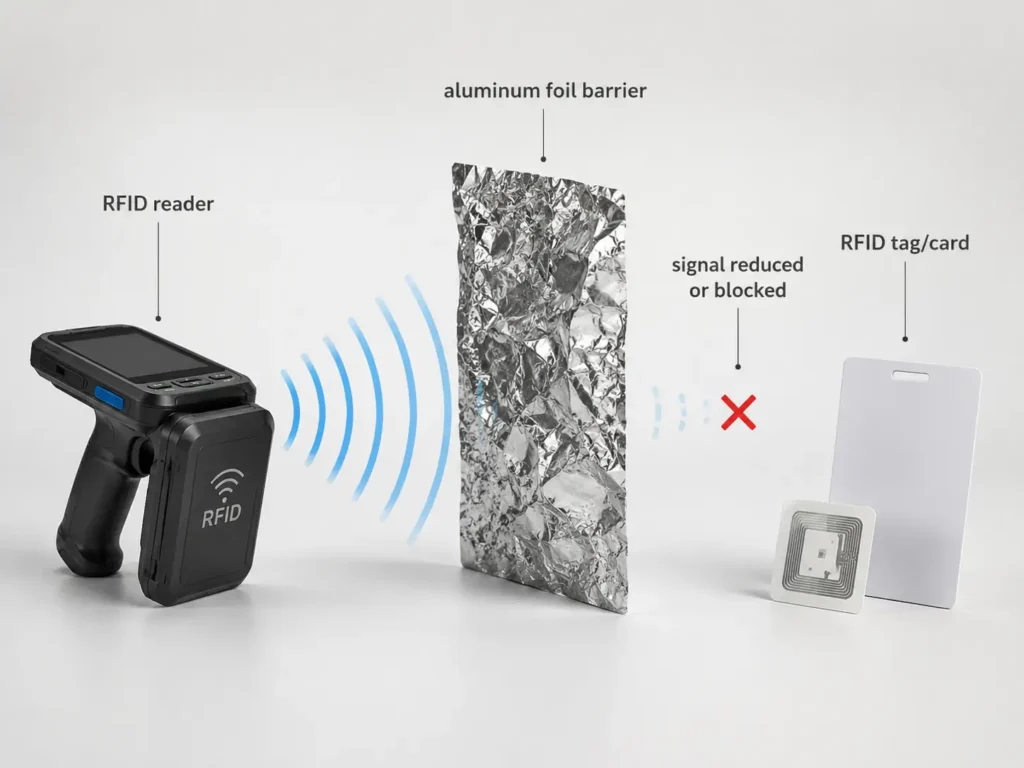
Aluminum foil affects RFID because it is conductive. RFID does not pass through foil the way it passes through paper, plastic, or fabric. Once metal sits close to a tag or card, it starts interacting with the energy the RFID system uses to communicate.
Foil is Conductive
That matters because a conductive material does not just sit there as a neutral cover. It becomes part of the electrical environment around the tag. In HF and NFC systems, metal near the antenna can generate eddy currents. Those currents create an opposing magnetic field, absorb power, and push the antenna away from its intended tuning.
It Interferes with the Electromagnetic Field
RFID depends on a stable field between the reader and the tag. Foil can disturb that field before the tag gets enough energy to respond, which can shorten read range, make reads inconsistent, or stop the read completely. Nearby metal reduces inductance and quality factor, which is why ferrite shielding is often added when NFC antennas must operate near metal.
It Can Reflect, Absorb, or Disrupt RFID Energy
Foil does not affect every RFID system in exactly the same way, but the main problems are consistent. Metal can absorb part of the energy, reflect RF waves, and interfere with the tag antenna. In UHF systems, reflected waves can create destructive interference, sometimes called null zones, and metal right against the tag can detune the antenna enough to make the tag unreadable or much harder to read.
How RFID Frequency Changes the Result
Foil can interfere with RFID, but the result is not the same for every type of RFID. The biggest reason is frequency. LF, HF/NFC, and UHF use different operating ranges and respond differently when metal is close to the tag or antenna.
LF RFID
LF RFID usually handles difficult materials better than higher-frequency systems. Tags in the 125 kHz or 134.2 kHz range are often more tolerant when they are attached to or placed near different surfaces, so foil does not always shut them down as easily as people expect. But it does not mean foil has no effect, but LF is generally less sensitive than HF, NFC, or standard UHF labels in this kind of situation.
HF and NFC at 13.56 MHz
HF and NFC are often easier to disrupt with foil. These systems rely on inductive coupling between the reader antenna and the tag antenna, so nearby metal changes the magnetic field the system depends on. Once foil gets close, it can create eddy currents, pull energy away from the tag, and push the antenna out of tune. That is why an NFC card or tag may work normally in the open but fail once it is wrapped tightly in foil or placed directly against metal.
UHF RFID
UHF RFID is usually the most sensitive to foil and metal, especially with ordinary passive labels. UHF tags depend heavily on antenna behavior and the surrounding RF environment, so foil can weaken communication, detune the tag, and make reads unstable. Standard UHF labels often struggle around metal, so many people are looking for specialized on-metal tags and metal-mount designs in the first place.
What Else Changes Whether Aluminum Foil Blocks RFID?
Frequency is only part of the answer. Even with the same RFID frequency, aluminum foil may block one tag completely and only weaken another. The difference often comes from how the tag is used and what is around it, including how much of the tag is covered, where the foil sits, and whether the tag is designed for use near metal.
Fully Wrapped Tag or Card
A full wrap gives foil the best chance of blocking an RFID read. When the tag or card is covered on all sides, the foil is much more likely to interrupt the field around it and prevent normal communication. A tightly enclosed card usually blocks better than a card with only one side covered.
Partially Covered Tag
Partial coverage is less predictable. In some cases it may reduce read range or make reads unstable rather than stop them completely. If part of the antenna area is still exposed, the reader may still get enough signal to power the tag and complete a read, especially at short distance.
Loose Foil with Gaps
Loose foil with folds, openings, or gaps is also less reliable. Once the shielding is incomplete, the result can shift from full blocking to partial interference.
Foil Near the Tag Instead of Wrapped Around It
Foil does not always need to touch the tag to cause problems. Metal close to the tag or in the read environment can still reflect energy, detune the antenna, or create null zones that make reads weaker or less consistent. In UHF systems especially, nearby metal in the environment can change the read zone even when the tag is not wrapped at all.
One Tag vs Tag Attached to Product Packaging
A single loose card or tag is easier to reason about than a tag attached to real packaging. Once a tag is mounted on a product, the surrounding materials can change the result. Foil packaging, metalized layers, or nearby metal parts may interfere with the tag much more than a simple open-air test would suggest.
Ordinary Tag vs Anti-Metal Tag

Tag design matters a lot. A standard RFID label often performs poorly near metal because the antenna can detune or the reflected energy can disrupt the read. Anti-metal or on-metal tags are built differently, often with a spacer or a design tuned for metal surfaces, so they can keep working in places where an ordinary tag would fail.
Does Aluminum Foil Block Common RFID Items?
After looking at frequency and tag design, it helps to look at the actual RFID items people use most often.
Does Aluminum Foil Block NFC Cards?
Often, yes. NFC cards use 13.56 MHz technology, and metal close to the antenna can create eddy currents, absorb power, and detune the antenna. A tightly wrapped NFC card is much more likely to fail than a card that is only partly covered.
Does Aluminum Foil Block RFID Credit Cards?
Contactless payment cards are one of the most common examples people have in mind when they ask this question. Since contactless card payments use NFC-type communication at 13.56 MHz, foil can often block or weaken the read if the card is fully enclosed. But if the foil coverage is incomplete, the card may still read at short range.
Does Aluminum Foil Block UHF RFID Labels?
Usually, yes, and often very effectively with standard labels. UHF RFID labels are highly sensitive to metal, so foil can detune the tag and disturb the read zone enough to stop normal reading. That is one reason metal-mount and on-metal UHF tags exist. A standard UHF label on foil packaging or near a metalized layer is much more likely to have read problems than a tag designed for that environment.
Does Aluminum Foil Block Key Fobs or Access Cards?
It depends on the technology inside them. Some access credentials use 125 kHz proximity technology, while others use 13.56 MHz smart card technology, and some combine both in one credential. Because of that, foil may block one access card more easily than another. In general, 13.56 MHz credentials are more likely to be disrupted by foil, while 125 kHz credentials are often more tolerant.
Does Aluminum Foil Block Passports and ID Cards?
Many e-passports and some modern ID documents use HF RFID at 13.56 MHz, so foil can often interfere with or block reading when the chip area is fully enclosed. As with other HF items, partial coverage is less reliable than full coverage.
Is Aluminum Foil a Reliable Long-Term RFID Blocking Solution?
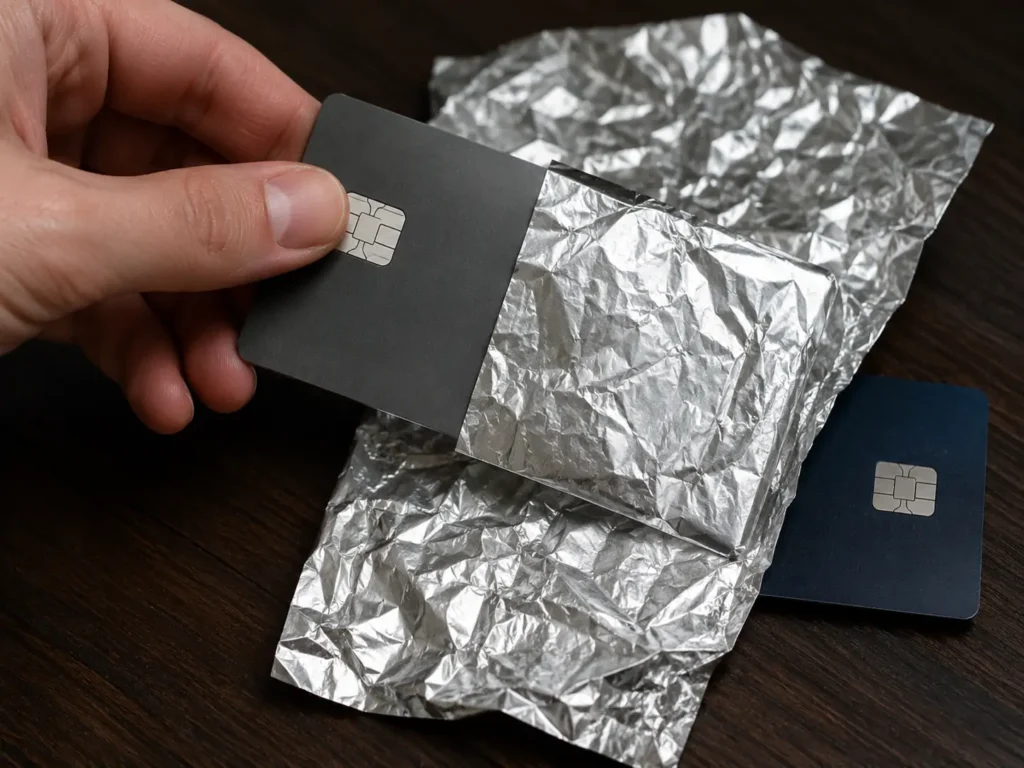
Aluminum foil can block or weaken RFID, but it is not a reliable long-term solution. It may work well in a quick test or in a one-time situation, especially when a card or tag is fully enclosed, but that is not the same as consistent day-to-day protection. Small changes in coverage, folds, gaps, and placement can change the result, so foil is better understood as a rough temporary shield than a stable blocking method.
If you need something more dependable, purpose-built RFID-blocking materials make more sense. These products are designed for repeatable performance with specific RFID frequencies, while ordinary household foil is not.
Better Alternatives to Aluminum Foil for Blocking RFID
Those more dependable options mainly fall into a few categories.
RFID-Blocking Wallets And Sleeves
RFID-blocking wallets and sleeves are the most common alternative for cards and passports. They are easier to carry, easier to reuse, and less likely to leave gaps than folded foil. For daily use, they are usually the simplest and cleanest option.
Shielding Pouches For Cards And Badges
Shielding pouches are useful when the item needs to stay protected in storage but still be easy to take out and use again. They make good sense for access cards, work badges, and similar credentials that are handled often.
Purpose-Built Shielding Materials
In RFID products and technical applications, more specialized shielding materials are often used instead of ordinary foil. These materials are chosen to give more stable results, especially when tags are placed near metal or used in more demanding environments.
Frequently Asked Questions
Does One Layer Of Aluminum Foil Block RFID?
Sometimes, but not always. One layer can be enough to weaken or block a read in some cases, especially when the card or tag is fully covered and the RFID system is more sensitive to metal. But the result still depends on the frequency, the antenna design, and whether there are gaps or exposed areas.
Does Aluminum Foil Block NFC?
Often, yes. NFC works at 13.56 MHz, and metal in the environment changes antenna behavior and affects NFC performance. NFC cards and tags usually work much worse when they are tightly wrapped in foil or placed directly against metal.
Can Foil Damage An RFID Card?
Usually, no. Foil mainly affects whether the card can be read, not whether the chip is permanently harmed. In most cases, the issue is temporary signal blocking or weakening rather than damage to the RFID chip itself.
Do RFID-Blocking Wallets Use The Same Basic Idea?
Yes. The basic principle is similar. Both foil and RFID-blocking products use conductive shielding to interfere with the radio communication a reader needs in order to talk to the card or tag. The difference is that purpose-built products are made to do this more consistently in everyday use.
What Kind Of RFID Tag Works Best Near Metal?
Tags designed for metal surfaces work best. In HF and NFC applications, ferrite shielding is commonly used to reduce the effect of nearby metal. In UHF applications, on-metal tags are built specifically for those environments because ordinary labels often lose performance near metal.
Conclusion
If you just want a quick way to test whether an RFID item can be shielded, aluminum foil can give you a rough answer. But for everyday use, it is not the best tool. A product made for RFID blocking is more practical when you want consistent protection, and a metal-compatible tag is the better choice when the tag still needs to work near metal.