RFID tags help businesses identify and track items faster, with less manual work and better data accuracy. They are used in many industries, from retail and logistics to livestock, laundry, and asset management, because they make it easier to know what something is, where it is, and how it moves through daily operations.
What Is an RFID Tag?
An RFID tag is a small electronic tag that stores data and communicates that data to an RFID reader through radio waves. RFID stands for Radio Frequency Identification. A typical RFID tag includes a microchip and an antenna. The chip holds the information, and the antenna helps transmit it to the reader when the tag is scanned.
How Do RFID Tags Work?
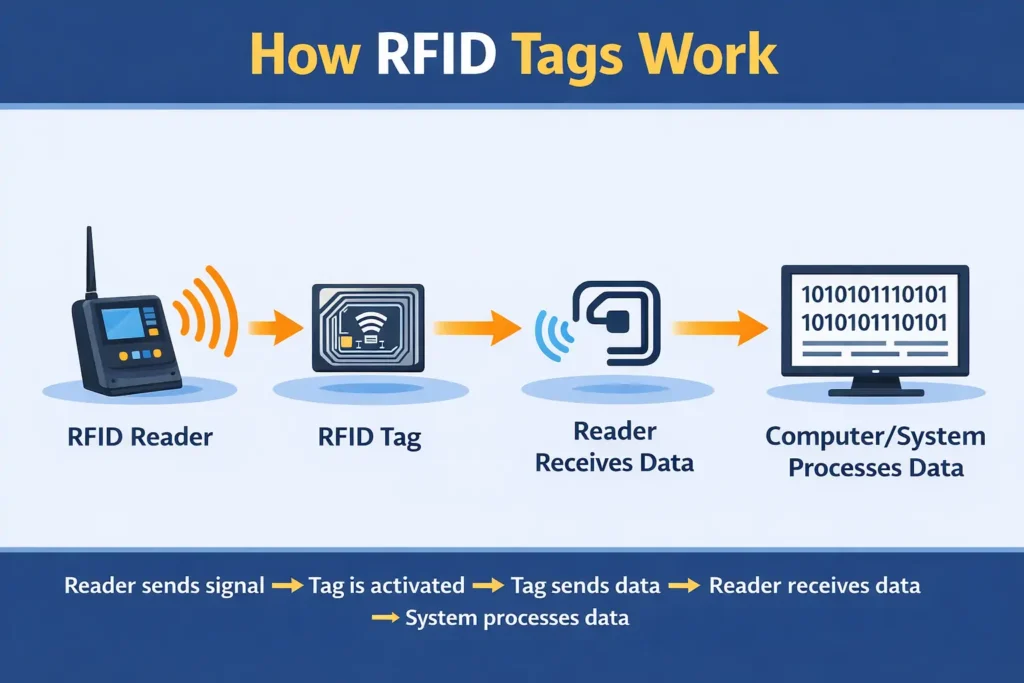
RFID tags work by communicating with an RFID reader through radio waves. When the tag enters the reader’s signal range, the reader sends out electromagnetic energy to detect it. In a passive RFID system, that energy powers the tag so it can respond. The tag then sends back its stored data, and the reader captures that information for the system to process. To put it simply, the reader sends a signal, the tag responds, and the system uses that response to identify the tagged item.
What Are RFID Tags Used For?
RFID tags are used to identify and track physical items in a faster and more accurate way. They help businesses capture data automatically, reduce manual work, and keep better visibility over items as they move through different parts of an operation.
RFID Tags for Inventory Management

RFID tags are widely used in inventory management to help businesses track stock more efficiently. Instead of checking items one by one by hand, staff can scan tagged products much faster and get more accurate inventory data. This helps reduce counting errors, improve stock visibility, and make it easier to know what is in stock, what is missing, and what needs to be restocked.
RFID Tags for Asset Tracking
RFID tags are also used to track business assets such as tools, equipment, containers, and reusable items. By attaching tags to these assets, companies can identify them quickly and record their movement more accurately. This helps reduce loss, improve traceability, and make day-to-day asset management more organized.
RFID Tags for Livestock Identification

In livestock management, RFID tags are used to identify animals and keep accurate records. Each tag carries a unique ID that can be linked to information such as breed, age, health records, or movement history. This makes animal identification faster, more reliable, and easier to manage across farms, transport, and traceability systems.
RFID Tags for Laundry Tracking

RFID tags are commonly used in laundry operations to track linens, uniforms, garments, and other washable textile items. They help businesses identify each item, monitor its movement, and improve control over sorting, counting, and return processes. This is especially useful in commercial laundries, hotels, hospitals, and uniform management systems.
RFID Tags for Access Control and Other Uses
RFID tags are also used in access control, retail, logistics, manufacturing, and many other fields. Depending on the application, they can be used to identify people, products, vehicles, documents, or equipment. The main role keeps the same: to make identification and tracking faster, more consistent, and easier to manage.
Types of RFID Tags We Offer
We offer a wide range of passive RFID tags to match different applications, environments, and system requirements. While our products focus on passive tags, tags with RFID technology are commonly grouped by power source, frequency, and form factor, including active and semi-passive types. Each type has its own features, performance strengths, and practical uses. Understanding these differences makes it easier to choose the right RFID tag for your project.
RFID Tags by Power Source
Passive RFID Tags
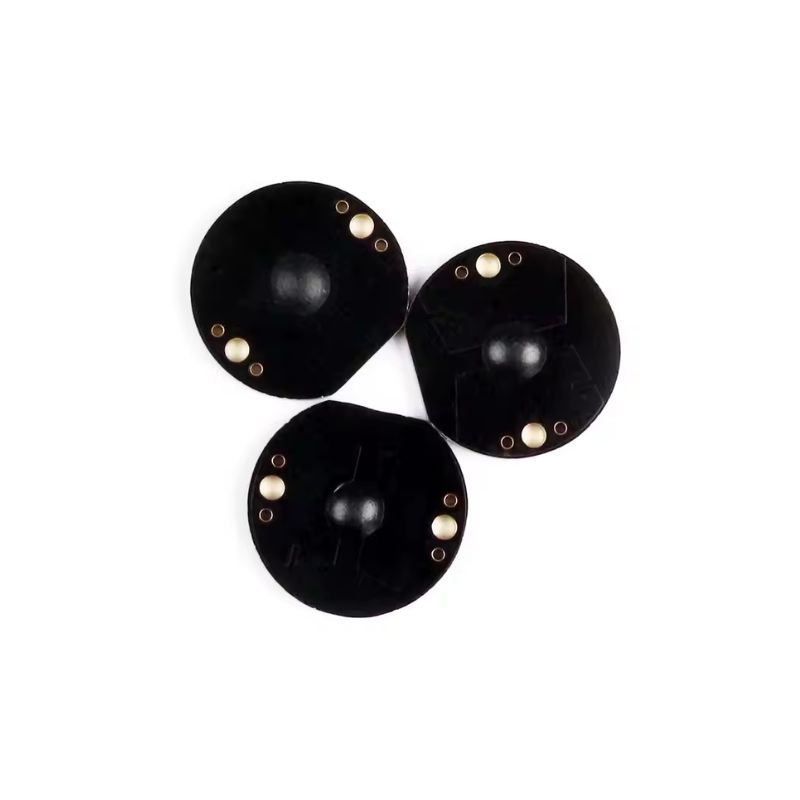
Passive RFID tags do not have a built-in battery. They rely on energy sent out by the RFID reader, then use that energy to power the chip and send back data. It is the most common type of RFID tag on the market because the structure is simple, the size can be very small, and the cost is usually lower than battery-powered options.
A passive tag is often the first choice when you need large quantities for inventory, retail, logistics, access control, library systems, asset tracking, or livestock identification. These tags can be made in many shapes, from thin labels and plastic cards to ear tags, laundry tags, and hard tags. Their read range depends on the frequency, the reader, the antenna design, and the surrounding environment, but in general they are chosen when you want a practical and scalable tagging solution without battery maintenance.
Active RFID Tags
Active RFID tags have their own internal battery. Because the tag has its own power source, it can support much longer read distances than a passive tag and is often used in applications that need wider-area tracking or continuous visibility.
These tags are usually larger, heavier, and more expensive than passive tags. They are often used for tracking vehicles, containers, high-value equipment, or moving assets across large sites. In some systems, active tags can also support extra functions such as sensor monitoring or real-time location-related applications. The stronger performance comes with trade-offs, especially higher cost and limited battery life, so they are usually chosen for more specialized projects rather than simple item-level tagging.
Semi-Passive RFID Tags
Semi-passive RFID tags, also called battery-assisted passive tags, sit between passive and active types. They contain a battery, but they do not transmit in the same way as a fully active tag. Instead, the battery helps power the chip or support sensing functions, while communication with the reader still depends on the RFID interaction.
These tags are often used in applications where a standard passive tag is not enough, but a fully active tag is not necessary. They may be used in condition monitoring, cold chain tracking, environmental sensing, or other systems where more stable performance is needed. Compared with passive tags, they are more complex and more expensive. Compared with active tags, they are usually more limited in signaling ability but can still offer better performance in certain use cases.
RFID Tags by Frequency
LF RFID Tags
LF RFID tags work at low frequency, most commonly 125 kHz or 134.2 kHz. Among these, 134.2 kHz is especially common in animal identification and livestock management systems. LF tags usually have a short read range, but they are known for stable performance in difficult environments, especially where moisture, dirt, or close contact with animal bodies can affect other tag types.
Because of this, LF RFID tags are widely used for livestock ear tags, pet microchips, access control, and some industrial identification tasks. Their data transfer speed is lower than higher-frequency systems, and they are not the first choice for reading many tags quickly at once. But when close-range identification and reliable reading matter more than speed, LF remains an important option.
HF RFID Tags
HF RFID tags usually operate at 13.56 MHz. This is one of the most widely used RFID frequencies and includes many card-based and short-range identification systems. NFC is also part of the HF family, which is why some HF tags can be read by smartphones if the chip and protocol are compatible.
HF tags are commonly used for smart cards, ticketing, library systems, membership cards, payment-related applications, document tracking, and item identification in controlled scan environments. Their read range is usually short to moderate, depending on the system design, but they offer a good balance of stable reading, compact tag design, and broad application support. They are often chosen when users need controlled, close-range scanning rather than long-distance bulk reading.
UHF RFID Tags
UHF RFID tags operate in the ultra high frequency range, commonly around 860 to 960 MHz, though the exact operating band can vary by country or region. UHF is the most common choice for inventory, warehousing, logistics, retail, pallet tracking, carton tracking, and many large-scale asset management applications.
Compared with LF and HF, UHF tags are often chosen for longer passive read range and faster multi-tag reading. This makes them very useful in situations where many items need to be identified quickly. At the same time, UHF systems are more affected by surrounding materials such as metal and liquids, so tag design, placement, and environment matter a lot. A UHF tag may perform very well in one setting and poorly in another if the wrong form factor or mounting method is used.
RFID Tags by Form Factor
RFID Labels
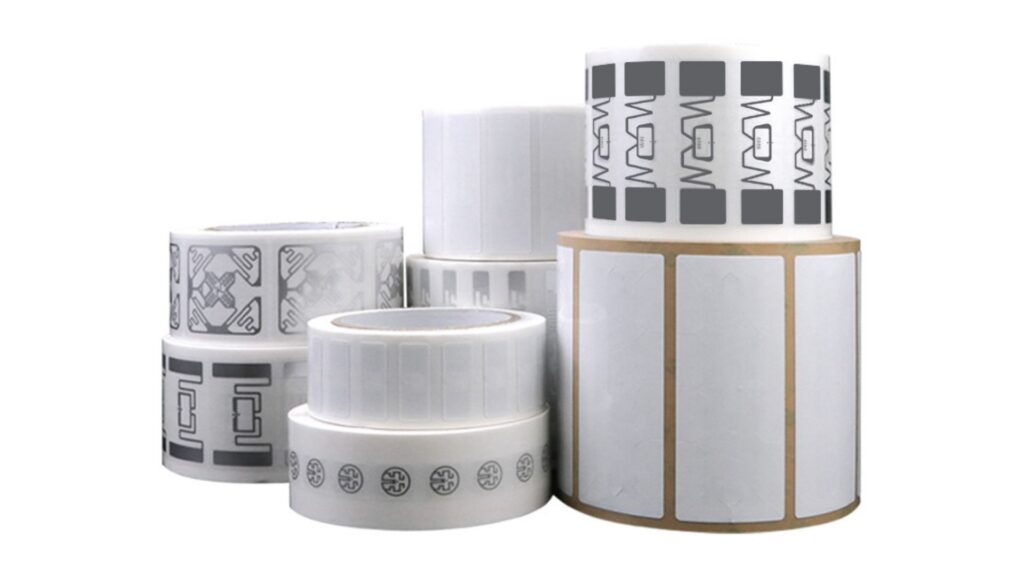
RFID labels are usually thin, flat, and flexible. They often look similar to ordinary adhesive labels, but inside they contain an RFID inlay with a chip and antenna. This form factor is widely used for retail goods, cartons, packages, files, and general inventory items because it is lightweight, low-profile, and suitable for large-volume application.
RFID labels are often chosen when the tag needs to sit directly on packaging or product surfaces without adding much bulk. They are practical for one-time or short-to-medium-term use, though the exact durability depends on the label material, adhesive, and environment.
RFID Cards and Key Fobs
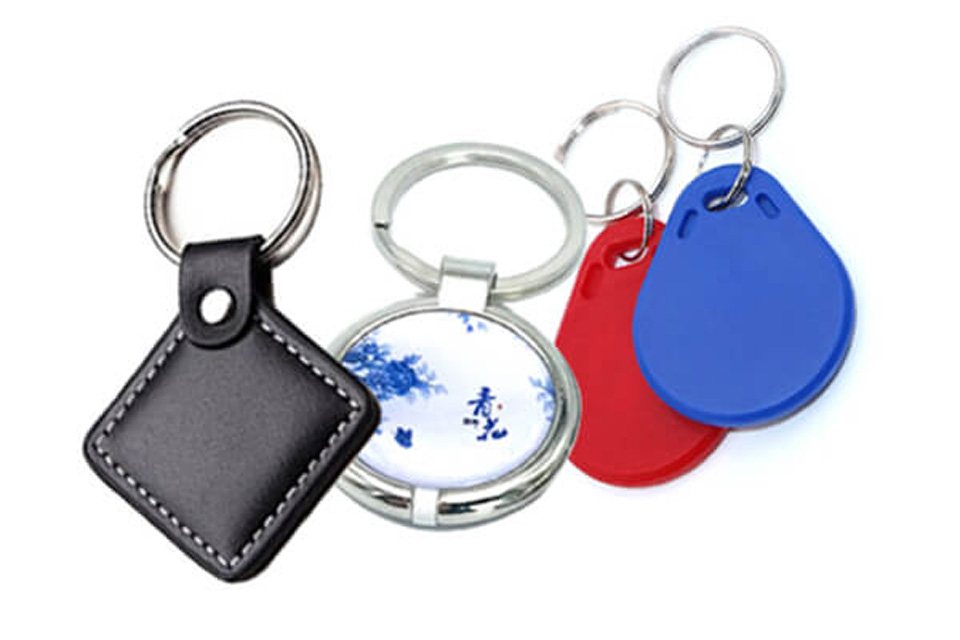
RFID cards are usually flat, rigid, and about the size of a standard ID card. Key fobs are smaller, thicker, and made for everyday carrying on a key ring. Both forms are common in access control, staff identification, attendance systems, membership programs, and secure entry applications.
Their physical shape makes them easy to carry, tap, scan, and reuse. Cards offer a larger printable surface for branding or ID details, while key fobs are more compact and portable. These tags are often chosen when the user needs something durable enough for repeated handling in daily life.
RFID Hard Tags
RFID hard tags have a solid outer housing, often made from ABS, engineering plastic, or other durable materials. They are usually thicker and more rigid than labels because they are designed to protect the chip and antenna from impact, pressure, moisture, dust, or rough handling.
This form factor is often used for tools, bins, pallets, containers, industrial assets, reusable transport items, and equipment that moves through demanding conditions. Hard tags may be attached with screws, rivets, cable ties, industrial adhesive, or molded mounting points, depending on the application. Their key advantage is stronger physical protection and longer service life.
RFID Wristbands
RFID wristbands are shaped to be worn comfortably on the wrist. Depending on the use, they may be made from silicone, PVC, woven fabric, paper, or soft plastic materials. Some are disposable for short-term events, while others are built for repeated use.
They are commonly used for access control, visitor identification, ticketing, healthcare identification, swimming venues, hotels, and cashless event systems. Their wrist-worn design makes them convenient when quick user identification is needed without relying on cards or handheld tokens.
RFID Laundry Tags
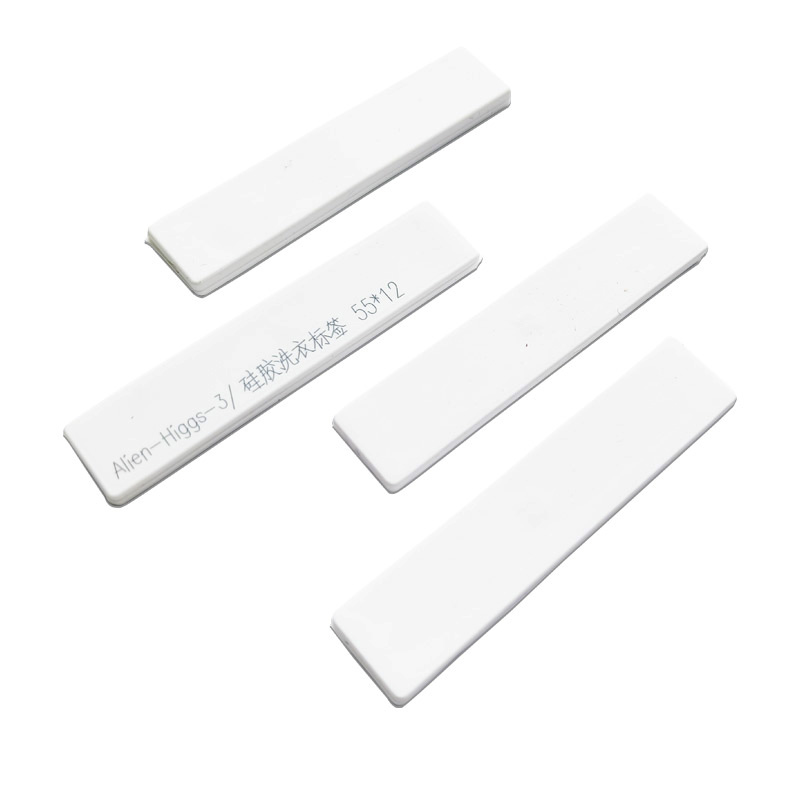
RFID laundry tags are usually small, compact, and designed to be sewn into or heat-sealed onto textiles. Many have a soft or flexible body so they can move naturally with fabric during use and washing. Some are narrow and strip-like, while others are patch-shaped or compact capsule-style tags designed for repeated industrial laundering.
These tags are used for linens, uniforms, garments, towels, workwear, and textile assets in commercial laundry, healthcare, hospitality, and uniform management systems. Their key feature is not just size, but resistance to repeated washing, drying, pressure, and heat. A normal label tag would fail quickly in these conditions, so laundry tags are built specifically for textile life cycles.
RFID Animal Ear Tags
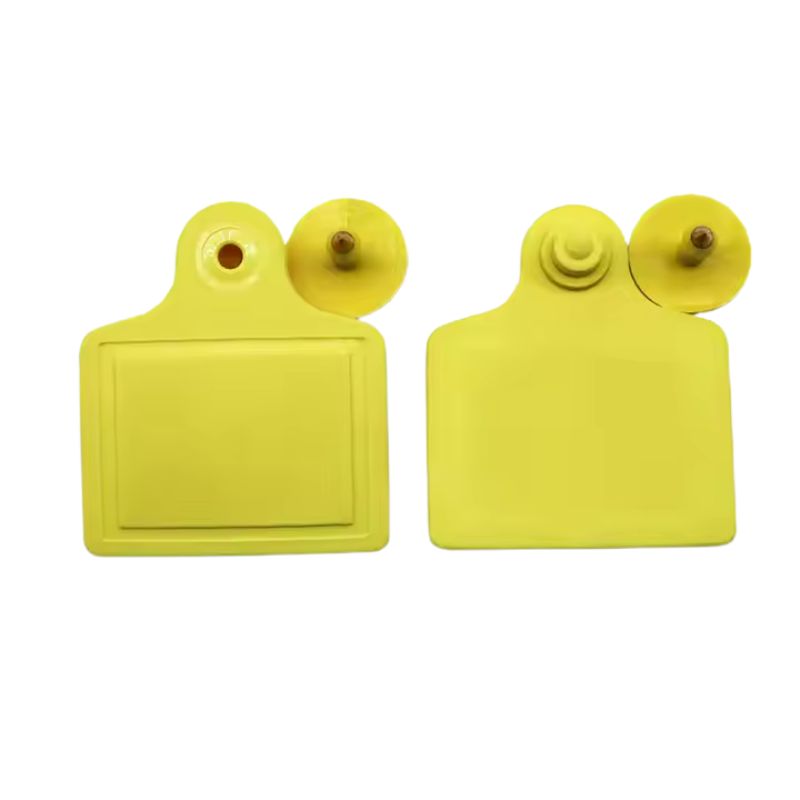
RFID animal ear tags are shaped to attach securely to the ear of livestock such as cattle, sheep, goats, or pigs. They are usually made from durable TPU or similar livestock-grade material and are designed to stay readable through outdoor exposure, animal movement, mud, rain, and daily farm handling.
This form factor is built around animal identification rather than shelf or package labeling. The shape needs to support secure fastening, visibility, and long-term use in farm conditions. These tags are commonly used for animal ID, traceability, health record linkage, breeding records, and herd management.
On-Metal RFID Tags

On-metal RFID tags are specially built for direct mounting on metal surfaces. Standard RFID tags often lose reading performance near metal because the metal interferes with the antenna behavior. On-metal tags solve this problem by using a special structure, spacer layer, or housing design that allows more stable operation in that environment.
They are often thicker than standard labels and may come as rigid hard tags, industrial plates, or specially designed adhesive tags. These are commonly used on machinery, tools, containers, IT assets, metal racks, pipes, and industrial equipment. The shape may vary, but the defining feature is that the tag is engineered specifically to work on metal, not just near it.
How RFID Tags Are Read
RFID tags are read with equipment such as handheld readers, fixed readers, antennas, and software systems. The exact setup depends on the application. A handheld reader is often used when staff need to move around and scan items in different locations, while a fixed reader is usually installed at doors, gates, conveyor lines, shelves, or workstations where tags need to be captured automatically.
In many systems, the reader works together with one or more antennas to create a defined read zone. This setup helps control where tags are detected and improves reading consistency. Once the tag data is captured, the system can link it to item records, movement history, or other stored information in the software.
Reading performance depends on the full setup, not just the tag itself. Frequency, reader power, antenna design, tag position, mounting surface, and nearby materials can all affect results. Metal, liquids, dense packaging, and poor tag orientation can reduce signal performance, which is why RFID systems need to be matched carefully to the real environment.
Advantages of RFID Tags
RFID tags offer several practical advantages over manual tracking methods and basic identification tools. One of the biggest is speed. RFID systems can capture tag data much faster than manual checking, and they can usually read multiple tagged items in a short time without scanning them one by one.
Another key advantage is better accuracy. Because the system reads data electronically, it can reduce human error in counting, recording, and tracking items. It is especially important and useful in operations where stock, assets, or moving items need to be identified quickly and consistently.
RFID tags also improve visibility. Once items are tagged, businesses can follow their movement more clearly across storage, production, transport, or daily use, which helps improve control, reduce loss, and support better record management.
Another benefit is that RFID does not depend on the same direct line-of-sight scanning as barcodes. A tag can often be read without needing the label to face the scanner exactly, which makes the process more flexible in many real working environments.
RFID tags can also be made for many different conditions. Depending on the application, they can be designed for laundry use, livestock identification, metal surfaces, outdoor exposure, industrial handling, or access control. This makes RFID suitable for a wide range of industries and operating environments.
Limitations of RFID Tags
RFID tags also have limitations, and understanding them is just as important as knowing their advantages. While RFID can improve speed, visibility, and automation, performance is never determined by the tag alone.
One common limitation is environmental sensitivity. Metal surfaces, liquids, dense packaging, and signal interference can all affect reading results, especially if the wrong tag type is used. A tag that works well in one setting may perform poorly in another if the material, placement, or frequency is not matched properly.
Cost is another factor. Basic RFID tags can be cost-effective in many projects, but the full system usually involves more than tags alone. Readers, antennas, software, installation, testing, and integration all add to the overall cost. For some businesses, that investment makes sense. For others, a simpler identification method may be enough.
RFID systems also require compatibility across the full setup. Not every tag works with every reader, and frequency alone is not the only issue. Protocol, chip type, application environment, and reader configuration all need to match. If the system is selected or installed poorly, performance problems are much more likely.
Another limitation is that not all RFID tags are built for harsh use. Some are made for low-cost labeling and short service life, while others are designed for washing, weather, impact, or industrial exposure. If durability needs are ignored at the start, the tag may fail much sooner than expected.
How to Choose the Right RFID Tag
Choosing the right RFID tag depends on how the tag will be used, what kind of reader system it needs to work with, and what conditions it must survive. A tag that works well on retail packaging may fail on metal equipment, washable textiles, or outdoor livestock use. The right choice comes from matching the tag to the real job.
Application
Application is the first factor to define because it affects almost everything else. RFID labels for cartons, ear tags for livestock, laundry tags for textiles, access cards for identification, and hard tags for industrial assets are built for very different purposes. A tag designed for one use should not be assumed to fit another. In most cases, the safest approach is to start with a tag made specifically for the application.
Frequency
Frequency affects reading behavior, system fit, and typical use environment. LF tags, usually 125 kHz or 134.2 kHz, are common in animal identification and other close-range uses. HF tags, usually 13.56 MHz, are often used in cards, ticketing, libraries, and NFC-related applications. UHF tags, commonly around 860 to 960 MHz, are widely used in inventory, warehousing, logistics, and asset tracking. The right choice depends on your read distance needs, reading speed, environment, and reader compatibility.
Read Range
Read range should match the actual operating distance of the application. Some systems only need close scanning, while others need tags to be read at gates, shelves, doors, or conveyor points. Real read range is not determined by the tag alone. It is affected by the full setup, including frequency, reader power, antenna design, tag size, placement, and nearby materials. A long read range on paper does not guarantee the same result in real use.
Surface and Environment
The mounting surface and surrounding environment strongly affect RFID performance. Tags placed on cardboard, plastic, fabric, glass, and metal do not behave the same way. Metal and liquids are especially important because they can reduce signal performance if the wrong tag is used. Heat, moisture, dirt, chemicals, outdoor exposure, and repeated handling also matter. The tag should be chosen for the actual environment, not just for the item itself.
Durability
Durability should match the service life and working conditions of the tagged item. A thin RFID label may be enough for packaging or document tracking, but it is not suitable for industrial tools, reusable containers, or textile items that go through repeated washing. Some RFID tags are designed to resist abrasion, pressure, UV exposure, chemicals, water, or high temperatures. If the application is demanding, durability needs to be treated as a core requirement, not an extra feature.
Reader Compatibility
The tag must work with the reader and system already in use or planned for the project. Matching frequency is only the first step. Protocol, chip type, antenna setup, operating standard, and software integration also affect compatibility. A tag may look correct by frequency alone and still fail in the real system if those details do not match. RFID tags should always be selected as part of a complete system, not as a standalone item.
Contact us now to find the RFID tags that best match your application, environment, and system requirements.
RFID Tags vs NFC Tags
NFC and RFID are related, but they are not the same thing. RFID is the broader technology family, while NFC is a specific type of high-frequency RFID used for very short-range communication. In other words, all NFC tags are RFID tags, but not all RFID tags are NFC tags.
The primary differences are:
- Frequency: NFC works at 13.56 MHz. RFID tags can work at several different frequencies, including LF at 125 kHz or 134.2 kHz, HF at 13.56 MHz, and UHF at around 860 to 960 MHz.
- Read range: NFC is designed for very close-range use, usually within a few centimeters. RFID read range varies much more depending on the system. Some RFID tags are meant for close scanning, while others can be read from much farther away.
- Reader type: NFC tags can often be read by smartphones and other NFC-enabled devices. Many RFID tags need dedicated RFID readers because they use different frequencies and protocols.
- Typical use: NFC is commonly used for mobile interaction, digital sharing, payment functions, and quick tap-based access. RFID is used more widely in inventory tracking, logistics, livestock identification, laundry systems, asset management, and industrial operations.
- Reading style: NFC is usually used for deliberate one-to-one interaction. RFID, especially UHF RFID, is often used for faster item identification and, in many systems, reading multiple tags within the same read zone.
FAQs About RFID Tags
What Is the Difference Between RFID Tags and Barcodes?
A barcode stores data in a printed visual pattern that must be seen by a scanner. An RFID tag stores data in a chip and sends it to a reader by radio signal. Barcodes are usually cheaper and simpler, but they normally need direct line-of-sight scanning and are often read one item at a time. RFID tags are better suited for faster data capture, reduced manual work, and applications where items need to be identified without precise visual alignment.
What Do RFID Tags Cost?
RFID tag cost varies a lot by type, material, durability, and order volume. Low-cost passive labels can start around $0.05 to $0.50 each in bulk, general-purpose tags often fall around $0.50 to $2.50 each, specialized tags such as on-metal, laundry, or high-temperature models often land around $0.75 to $4.00+ each, and active RFID tags are often much higher, commonly around $15 to $50 each. The final cost depends on the tag design, chip, housing, and quantity.
How to Attach RFID Tags
The right attachment method depends on the item, the surface, and the environment. Common methods include adhesive backing, epoxy, sewing, straps, hanging methods, cable ties, and more permanent options such as screws or rivets. For hard tags and industrial tags, embedded mounting points or rigid housings are also common. The key is not just making the tag stay on the item, but making sure it stays readable after attachment.
How to Use RFID on Difficult-to-Tag Items
Difficult-to-tag items usually need a tag chosen for the material and shape, not a standard label used by default. Metal objects often need on-metal RFID tags. Textiles may need laundry tags or sewn-in tags. Small, curved, rough, or high-impact surfaces may need a hard tag, cable-tie tag, epoxy mounting, or a custom attachment method. In many RFID projects, the tag type and the attachment method have to be matched together to get stable reading results.
Can RFID Tags Be Tracked?
Yes, but tracking does not always mean real-time live location. Passive RFID tags are usually tracked when they pass through a reader’s read zone, such as a gate, shelf, workstation, or checkpoint. Active RFID tags can support more continuous tracking because they use a battery and can broadcast over much longer distances. So RFID can support tracking, but the level of visibility depends on whether the system is passive, active, or combined with other location technologies.
Can RFID Tags Be Hacked?
Yes, RFID tags can be hacked, cloned, or read without authorization if the system is poorly protected. NIST specifically notes cloning as a documented RFID threat, where information from a legitimate tag is copied to another tag or device. In real use, the risk depends on the tag type, the data stored on it, and the security controls in place, such as encryption, authentication, and access control.
Can RFID Tags Track Location?
Sometimes, but not by themselves in every system. Most passive RFID tags do not provide continuous live location. They simply report their identity when they enter a reader’s range. More advanced location tracking usually needs active RFID, RTLS, GPS-enabled tags, Wi-Fi-enabled tags, or additional infrastructure that can calculate location from tag signals. So an RFID tag can be part of a location system, but a standard passive tag is not the same thing as GPS.
Request a Quote Now!
Looking for RFID tags that match real working conditions, not just basic specifications? JIA RFID provides industrial RFID tags for inventory, logistics, manufacturing, laundry, livestock, access control, and asset tracking, along with compatible RFID readers and technical support for project deployment. We also offer flexible customization in size, material, chip selection, and printing, and each batch is tested for durability, consistency, and read reliability before shipment. As a factory-direct manufacturer, we handle production, quality inspection, and delivery in-house, which helps support stable quality, competitive pricing, and faster lead times for custom orders. Contact us today to get a quote and find the right RFID tag for your application.